

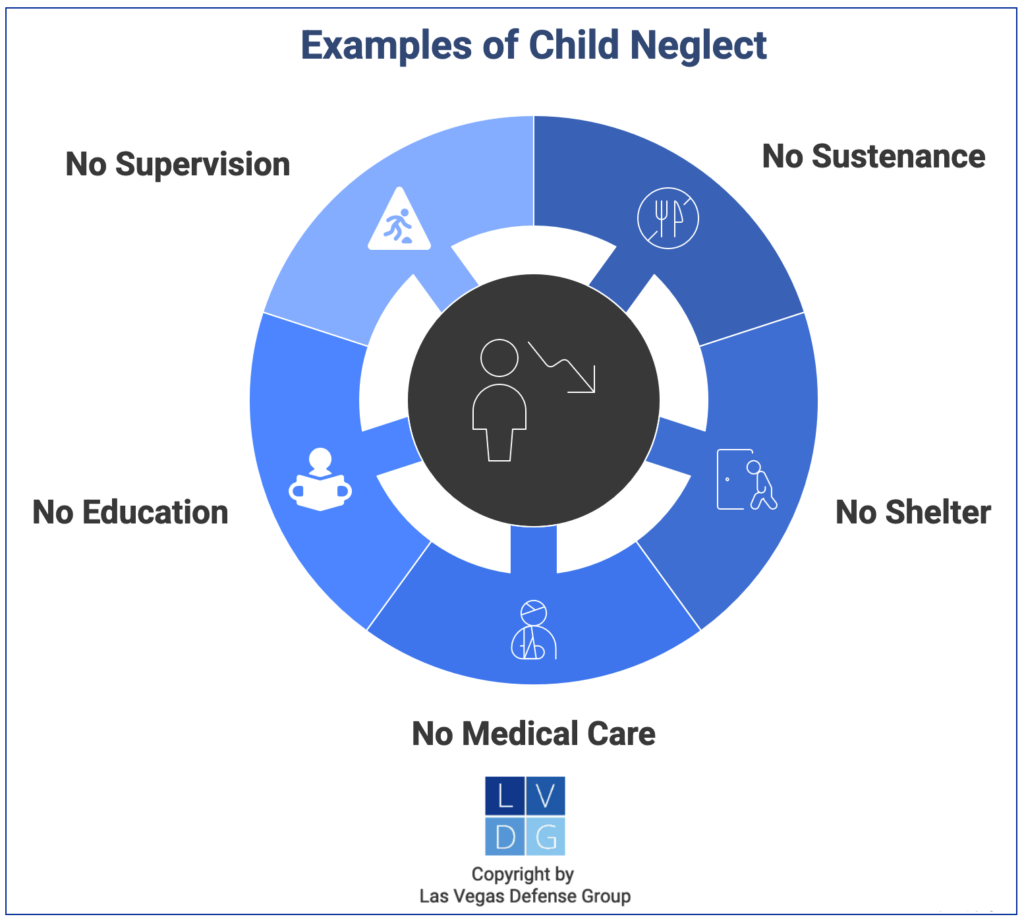
In Nevada, neglecting a child under 18 becomes a crime when you abandon them or deprive them of sufficient:
- Food and water,
- Education,
- Housing,
- Medical care,
- Supervision, or
- Other necessities.
Therefore, child neglect is a crime of inaction – of what you are not doing for a child. This is in contrast to child abuse, which is actively harming a child (such as by hitting them beyond reasonable corporal punishment).
Certainly, punishing your child by sending them to bed without dinner for one night is not criminal child neglect. Though failing to feed them at all for long stretches would be.1
In our experience handling child neglect cases in Nevada, these allegations are rarely as simple as they first appear in a police report. We often see cases arise from difficult parenting decisions, misunderstandings about supervision, medical care, unsafe living conditions, or accusations made during contentious family disputes.
The difference between a questionable parenting decision and criminal child neglect depends on the specific circumstances, what the caregiver knew at the time, and whether the child was actually placed at risk. Those details are critical when evaluating a potential charge and building a strong defense under Nevada law.
In this article, our Las Vegas criminal defense attorneys will address the following child neglect topics:
- 1. Are injuries required to be convicted?
- 2. What about medical decisions?
- 3. What are the penalties?
- 4. How do I fight the charges?
- Frequently Asked Questions
- Additional Resources
Are injuries required to be convicted?
No. In Nevada, merely the act of neglecting a child is the crime irrespective of whether injuries occur.
That being said, Nevada imposes more severe penalties if the child sustains substantial bodily harm or mental harm. Examples of such injuries I have seen include:
- Unconsciousness (from being hungry or not getting medical treatment),
- Organ damage (from starvation),
- Lacerations (from exposure to the elements), or
- PTSD (from abandonment).2

What about medical decisions?
If you are a parent or guardian to a minor child in Nevada, state law permits you to administer alternative medicines or non-medical treatments if the following two conditions are met:
- The medical community recognizes these treatments as suitable alternatives to standard medical intervention, and
- You choose these alternative treatments in good faith.
It is usually easy to prove that you acted in good faith. Though to show that your treatments were reasonable alternatives, I typically call upon medical expert witnesses to testify on your behalf.3
What are the penalties?
In Nevada, child neglect that results in substantial bodily or mental harm is usually a category B felony in most cases. This carries two to 20 years in prison.
Meanwhile, if the child sustains no substantial bodily or mental harm, willful child neglect is a category B felony. The sentence is either:
- 1 to 6 years in prison if you have no prior child abuse/neglect convictions; or
- 2 to 15 years in prison if you do have a prior child abuse/neglect conviction.
Finally, if you merely permitted the child neglect to occur – and no substantial bodily or mental harm occurred – then you face either a:
- Gross misdemeanor if you have no prior child abuse convictions. This carries up to 364 days in jail and/or $2,000; or
- Category C felony if you have a prior child abuse conviction. This carries 1 to 5 years in prison and up to $10,000.
Depending on your case, it may be possible to get probation in lieu of part or all of your sentence. You will also likely be ordered to complete a course of counseling.4

How do I fight the charges?
Here at Las Vegas Defense Group, I have represented literally thousands of people charged with child-related crimes such as neglect. In my experience, the following three defenses have proven very effective with prosecutors, judges, and juries at getting NRS 200.508 charges reduced or dismissed.
- The incident was an accident. For example, perhaps the only reason you were not administering a necessary medication to your infant is because you genuinely thought your nanny was doing it. As long as you did not cause or permit the neglect knowingly, criminal charges should not stand.
- You were falsely accused. Children sometimes lie out of anger, revenge, or just to get attention. Or perhaps a mandatory reporter made an inaccurate report in good faith. As long as the D.A. cannot prove beyond a reasonable doubt that you committed child neglect, your case should be dropped.
- The police committed misconduct. It is not uncommon for police to make mistakes, such as conducting an unlawful search or coercing a confession. If the judge agrees to suppress any state evidence found through the police’s misconduct, prosecutors may be forced to dismiss your case for lack of proof.
Typical evidence in child neglect cases includes video surveillance, medical records, and eyewitness accounts.

Frequently Asked Questions About Nevada Child Neglect Law
What is considered child neglect in Nevada?
Under Nevada law, child neglect generally means abandoning a child or failing to provide the care necessary for the child’s well-being. This can include inadequate food, shelter, education, medical care, supervision, or other necessary care. Nevada’s child neglect law is primarily found in NRS 200.508, with negligent treatment or maltreatment further defined in NRS 432B.140.
Neglect does not necessarily require physically injuring a child. A parent, guardian, caregiver, or other person responsible for a child’s welfare may face criminal liability when the circumstances threaten the child’s health or welfare.
Who can be charged with child neglect in Nevada?
A child neglect charge is not limited to a child’s biological parents. Depending on the circumstances, Nevada law can apply to a parent, guardian, stepparent living with the child, certain adults regularly living in the child’s household, and people or facilities responsible for providing the child with care.
The key question is generally whether the person had responsibility for the child’s safety or welfare and either caused the neglect or knowingly permitted it to occur.
Does Nevada child neglect law require intent to harm the child?
No. Prosecutors generally do not have to prove that a defendant specifically wanted a child to be harmed.
However, the person’s state of mind still matters. NRS 200.508 distinguishes between willfully causing abuse or neglect and permitting or allowing it to happen. Nevada law defines “allow” as failing to prevent or stop abuse or neglect when the person knows or has reason to know it is occurring.
This distinction is important because willfully causing neglect can carry substantially greater criminal penalties than merely permitting it.
Can you be charged with child neglect in Nevada if the child was never injured?
Yes. A child does not have to suffer an actual physical injury for conduct to violate Nevada’s child neglect law.
NRS 200.508 can apply when a child is placed in circumstances in which the child’s health or welfare is threatened, or the child may suffer unjustifiable physical pain or mental suffering. Actual substantial bodily or mental harm can increase the potential punishment, but the absence of an injury does not automatically prevent criminal charges.
Is leaving a child home alone considered neglect in Nevada?
It can be. Nevada’s child neglect statutes focus on whether the child was left without proper care, control, or supervision, rather than establishing one universal age at which every child may safely stay home alone.
Whether leaving a child alone amounts to criminal neglect therefore depends on circumstances such as the child’s age and maturity, how long the child was left alone, the safety of the environment, whether the child could obtain help, and whether the lack of supervision created a foreseeable danger.
Leaving a young child alone for an extended period is far more likely to raise child neglect concerns than briefly leaving a sufficiently mature child in safe circumstances.
Is leaving a child unattended in a car child neglect in Nevada?
It may lead to child neglect or endangerment allegations, but Nevada also has a separate law – NRS 202.485 – specifically addressing certain situations in which young children are left unattended in motor vehicles.
Depending on the facts, police may investigate conduct involving an unattended child in a vehicle under the vehicle-specific statute, NRS 200.508, or both. Factors such as the child’s age, weather, vehicle conditions, length of time, and degree of danger may be important.
What is the difference between child neglect and child endangerment in Nevada?
Child neglect generally involves failing to provide necessary care, while child endangerment generally involves placing or leaving a child in a dangerous situation.
For example, repeatedly forgetting to provide a child with sufficient food or necessary medical care may be neglect. Knowingly leaving a child in a dangerous environment may be endangerment.
Both forms of conduct can fall under Nevada’s NRS 200.508, and the same incident may potentially involve more than one theory of liability.
Can poverty be considered child neglect in Nevada?
Not necessarily. Nevada’s definition of negligent treatment or maltreatment refers to a person’s neglect or refusal to provide necessary care when able to do so.
It matters whether a family lacks food, housing, medical treatment, or other necessities because of genuine financial hardship rather than a caregiver’s refusal or neglect. Whether criminal neglect occurred will depend on the particular facts, including the caregiver’s ability to provide care and the steps taken to protect the child despite any genuine financial hardship.
Can not taking a child to the doctor be child neglect in Nevada?
Yes, under some circumstances. Nevada includes necessary medical care among the forms of care parents and other responsible caregivers are generally expected to provide.
However, Nevada law also recognizes a limited exception when a parent or guardian, acting in good faith, relies on a legally recognized nonmedical remedial treatment instead of conventional medical treatment.
Whether a particular medical decision constitutes neglect will depend heavily on the child’s condition, the necessity of treatment, the caregiver’s knowledge, and the reasonableness of the decision.
Is seeking mental health treatment for a difficult child considered neglect in Nevada?
No, not solely for that reason. Nevada law now expressly provides that a person responsible for a child’s welfare does not violate NRS 200.508 merely because the person seeks to have the child admitted to a public or private mental health facility or hospital when the child’s behavioral-health needs pose a risk to the safety and welfare of the family.
The law likewise provides protection based solely on bringing into the home a biological, foster, or adopted child whose behavioral-health needs pose such a risk.
This provision is important for families dealing with severe behavioral-health crises because seeking appropriate help does not, by itself, constitute child abuse or neglect.
What is the difference between a CPS investigation and a criminal child neglect case in Nevada?
A Child Protective Services investigation and a criminal prosecution are separate proceedings, although they may arise from the same allegations.
A child welfare agency focuses primarily on the child’s safety and may investigate the home, interview family members, establish a safety plan, or pursue proceedings affecting placement or custody. A criminal case involves law enforcement and prosecutors seeking to prove a violation such as NRS 200.508 beyond a reasonable doubt.
As a result, a parent or caregiver may encounter CPS even when no criminal charge is ultimately filed, and information developed during a child welfare investigation may become relevant to a criminal investigation.
Who must report suspected child neglect in Nevada?
Nevada requires numerous professionals to report suspected child abuse or neglect when they know or have reasonable cause to believe it occurred. Mandatory reporters include many health care professionals, teachers and school employees, child-care providers, law enforcement officers, certain attorneys, clergy in specified circumstances, and other professionals who work with children.
Generally, a required report must be made as soon as reasonably practicable and no later than 24 hours after the mandatory reporter knows or has reasonable cause to believe that abuse or neglect occurred.
Can a child neglect conviction be sealed in Nevada?
Some Nevada child neglect convictions may eventually be eligible for record sealing, depending on the offense and the circumstances of the conviction.
Gross misdemeanor convictions are usually sealable two years after the case ends. Category B or C felony convictions are usually sealable five years after the case ends. If the case involved a sex offense, the conviction is likely unsealable.
Can a Nevada child neglect charge affect immigration status?
Potentially. A child neglect conviction can create serious immigration consequences for a person who is not a U.S. citizen, depending on the precise statute, conduct alleged, and immigration status involved.
Immigration law does not classify every state conviction the same way. Anyone facing an NRS 200.508 charge who is not a U.S. citizen should therefore have the potential immigration consequences evaluated before accepting a plea agreement.
What evidence is used in a Nevada child neglect case?
Evidence in a Nevada child neglect investigation may include medical records, school attendance records, photographs or video, text messages, home conditions, witness statements, statements made by the child, CPS records, police body-camera footage, and testimony from doctors or other experts.
The prosecution still has the burden of proving every required element of the criminal offense beyond a reasonable doubt. Evidence showing that the incident was accidental, that the defendant reasonably believed another caregiver was providing necessary care, or that an accusation is unreliable is therefore important to crafting an effective defense.
Additional Resources
If you or someone you know is in immediate crisis, call 911. You can find further helpful information here:
- ChildAbuse.com – Another resource page with articles and links for the prevention of child abuse.
- Prevent Child Abuse Nevada (PCA Nevada) – Provides services and advocacy statewide for the prevention of child abuse in Nevada.
- Child Abuse Hotline in Clark County, Nevada – (702) 399-0081 or [email protected].
- National Center on Shaken Baby Syndrome – Information about SBS.
- Children’s Advocacy Centers of Nevada – An organization dedicated to helping victimized children.
Legal References
- NRS 200.508. NRS 432B.140. NRS 200.5085 – Negligent treatment or maltreatment (“Negligent treatment or maltreatment of a child occurs if a child has been subjected to harmful behavior that is terrorizing, degrading, painful or emotionally traumatic, has been abandoned, is without proper care, control or supervision or lacks the subsistence, education, shelter, medical care or other care necessary for the well-being of the child because of the faults or habits of the person responsible for the welfare of the child or the neglect or refusal of the person to provide them when able to do so.”). See also King v. State (Nev. 1989) 784 P.2d 942. See also Dixon v. State (Nev. 2025) 569 P.3d 623 (unpublished).
- Same. See also Newson v. State (Nev. 2020) 462 P.3d 246.
- NRS 200.5085. Martineau v. Angelone (9th Cir.1994) 25 F.3d 734.
- NRS 200.508.