





Using or possessing a fake driver’s license in Nevada can be a misdemeanor or felony, depending on what you did with the ID and why you had it. Nevada’s main fake ID laws are NRS 483.530, NRS 205.460, NRS 205.463, and NRS 205.465.
Nevada Fake Driver’s License Laws
- False or altered license: Possessing, displaying, altering, counterfeiting, lending, or using certain false driver’s licenses is generally a misdemeanor.
- Fake ID for alcohol or gambling: A person under 21 who uses false identification to obtain alcohol or gamble commits a misdemeanor.
- Fake identity: Possessing an ID to establish a false identity is generally a category E felony.
- Selling or transferring a fake ID: This is generally a category C felony.
- Identity theft: Knowingly obtaining and using another person’s identifying information with the intent to commit an unlawful act can be a category B felony.
The exact charge depends on the type of ID, whether it belonged to another real person, and whether you intended to use it to lie about your age, establish a false identity, or commit another crime.1
Therefore, the reason you had the ID matters as much as what the card looked like. A fake ID used by a college student to enter a casino is treated differently from a counterfeit license used to open accounts or steal another person’s identity.
In this article, I explain everything you need to know about Nevada fake driver’s license laws.
NRS 483.530
Nevada Revised Statute 483.530 makes it a misdemeanor to:
- possess or display a canceled, revoked, suspended, fictitious, fraudulently altered, or fraudulently obtained license;
- alter, forge, substitute, or counterfeit a driver’s license;
- lend a driver’s license to someone else;
- use another person’s license as your own; or
- reproduce a license so it could be mistaken for a genuine license.
Giving false information or committing fraud when applying for a driver’s license or identification card is generally a category E felony. However, it is a misdemeanor when the false information relates only to age.
A misdemeanor carries up to six months in jail and/or up to $1,000 in fines. A category E felony generally requires probation and a suspended sentence, but when imprisonment is permitted, it carries one to four years in Nevada State Prison and a possible fine of up to $5,000.2
NRS 205.460
Nevada Revised Statute 205.460 addresses false identification used by people under 21 to obtain alcohol or participate in gambling. It prohibits:
- making, altering, forging, or counterfeiting an identification document with the intent that someone under 21 use it to misrepresent their age to obtain alcohol, enter a gambling establishment, or gamble;
- selling, lending, giving, or offering such false identification to someone under 21; and
- using or attempting to use false identification while under 21 to obtain alcohol, enter a gambling establishment, or gamble.
Making or using false identification for these purposes is a misdemeanor, punishable by up to six months in jail and/or up to $1,000 in fines. Selling, lending, giving, or offering the false identification to someone under 21 is a gross misdemeanor, punishable by up to 364 days in jail and/or up to $2,000 in fines.3
In my experience, NRS 205.460 most often applies to young people using altered licenses at bars, liquor stores, nightclubs, or casinos. The prosecution must prove the accused person’s age, conduct, and intended use of the identification.
NRS 205.463
Nevada Revised Statute 205.463 addresses identity theft involving another person’s personal identifying information. This law generally applies when a person knowingly obtains someone else’s identifying information and, with the intent to commit an unlawful act, uses it to:
- harm that person;
- represent or impersonate that person to obtain access to personal identifying information;
- access certain nonpublic records; or
- obtain credit, goods, services, or anything else of value in that person’s name.
The potential penalties depend on how the information was used and whether aggravating circumstances were present:
- Basic identity theft: Knowingly obtaining and using another person’s identifying information with the intent to commit an unlawful act for a purpose prohibited by the statute is a category B felony carrying one to 20 years in prison and a possible fine of up to $100,000. Also, the court must order restitution, including qualifying costs incurred to repair the victim’s credit history or satisfy debts, liens, or other obligations resulting from the offense.
- Avoiding or delaying prosecution: Knowingly obtaining and using another person’s identifying information to avoid or delay prosecution for an unlawful act is generally a category C felony carrying one to five years in prison and a possible fine of up to $10,000.
- Aggravated identity theft: A violation involving the identifying information of an older or vulnerable person or five or more people, causing at least $3,000 in financial loss or injury, or using another person’s information to avoid prosecution for certain category A or B felonies, is a category B felony carrying three to 20 years in prison and a possible fine of up to $100,000.
Possession of the personal identifying information of five or more people, outside the statutory exemptions, also permits a “rebuttable inference” that the person intended to use the information unlawfully.4
In my experience, NRS 205.463 most often applies when a fake or stolen identity is allegedly used to obtain money, credit, goods, services, or access to private accounts or records. Unlike an age-only fake-ID offense, a charge under this statute requires allegations involving another person’s identifying information and an unlawful use specified by the law.
NRS 205.465
Nevada Revised Statute 205.465 makes it unlawful to possess, sell, or transfer a document or personal identifying information for the purpose of establishing a false status, occupation, membership, license, or identity. The possible charge depends on what the person allegedly intended to do:
- False proof of age only: Possession solely to misrepresent age, including to gamble or purchase alcohol, cigarettes, or other tobacco products, is a misdemeanor carrying up to six months in jail and/or up to $1,000 in fines.
- False identity or status: Possession for another false-identity or false-status purpose is generally a category E felony. The court generally must impose probation and a suspended sentence, although one to four years in prison and a possible fine of up to $5,000 may apply when imprisonment is permitted.
- Selling or transferring the material: Selling or transferring a document or identifying information for a false identity or status is generally a category C felony carrying one to five years in prison and a possible fine of up to $10,000.
- Using it to commit specified crimes: Possessing the material to commit forgery, certain computer crimes, or payment card offenses is generally a category C felony carrying one to five years in prison and a possible fine of up to $10,000.
- Aggravating circumstances: Selling or transferring the identifying information of an older or vulnerable person or five or more people—or causing at least $3,000 in loss or injury—is a category B felony carrying one to 20 years in prison and a possible fine of up to $100,000.
Possession of the personal identifying information of five or more people also permits a “rebuttable inference” that the person intended to use it unlawfully.4
I often explain that NRS 205.465 is broader and potentially more serious than the underage fake-ID statute. A card used only to appear old enough to enter a casino may be a misdemeanor, while documents intended to create a false identity or facilitate financial fraud can lead to felony charges.

Penalties For A Fake Driver’s License
The following table summarizes the potential punishments for driver’s license crimes in Nevada:
|
Fake Driver’s License Offense |
Nevada Penalties |
| Using or attempting to use a fake ID while under 21 to obtain alcohol, enter a gambling establishment, or gamble (NRS 205.460) | Misdemeanor: Up to six months in jail and/or up to $1,000 in fines |
| Making a fake ID for an under-21 person to obtain alcohol or gamble (NRS 205.460) | Misdemeanor: Up to six months in jail and/or up to $1,000 in fines |
| Selling, lending, giving, or offering a fake ID to a person under 21 for alcohol or gambling (NRS 205.460) | Gross misdemeanor: Up to 364 days in jail and/or up to $2,000 in fines |
| Possessing or displaying a fictitious, fraudulently altered, or fraudulently obtained driver’s license, or committing another prohibited act under NRS 483.530(1) | Misdemeanor: Up to six months in jail and/or up to $1,000 in fines |
| Possessing a document or identifying information solely to establish false proof of age, including to gamble or purchase alcohol, cigarettes, or other tobacco products (NRS 205.465) | Misdemeanor: Up to six months in jail and/or up to $1,000 in fines |
| Possessing a document or identifying information to establish a false status, occupation, membership, license, or identity (NRS 205.465) | Category E felony: Probation and a suspended sentence in most cases; if prison is permitted, one to four years; and up to $5,000 in fines |
| Selling or transferring a document or identifying information to establish a false identity or status (NRS 205.465) | Category C felony: One to five years in prison and up to $10,000 in fines |
| Possessing a fake ID to commit forgery, payment-card fraud, or specified computer crimes (NRS 205.465) | Category C felony: One to five years in prison and up to $10,000 in fines |
| Knowingly obtaining and using another person’s identifying information with the intent to commit an unlawful act for a purpose specified in NRS 205.463 | Category B felony: One to 20 years in prison; up to $100,000 in fines; and restitution |
| Aggravated identity theft involving an older or vulnerable person, five or more people, at least $3,000 in loss or injury, or another circumstance specified in NRS 205.463(3) | Category B felony: Three to 20 years in prison and up to $100,000 in fines; restitution applies when required by NRS 205.463(4) or other applicable law |
| Selling or transferring the identifying information of an older or vulnerable person or five or more people, or causing at least $3,000 in loss or injury (NRS 205.465) | Category B felony: One to 20 years in prison and up to $100,000 in fines |
These classifications and sentencing ranges come from Nevada’s fake ID, identity theft, driver’s license, and general penalty statutes. Restitution may also be ordered when legally applicable.5
What Happens If You Are Under 18
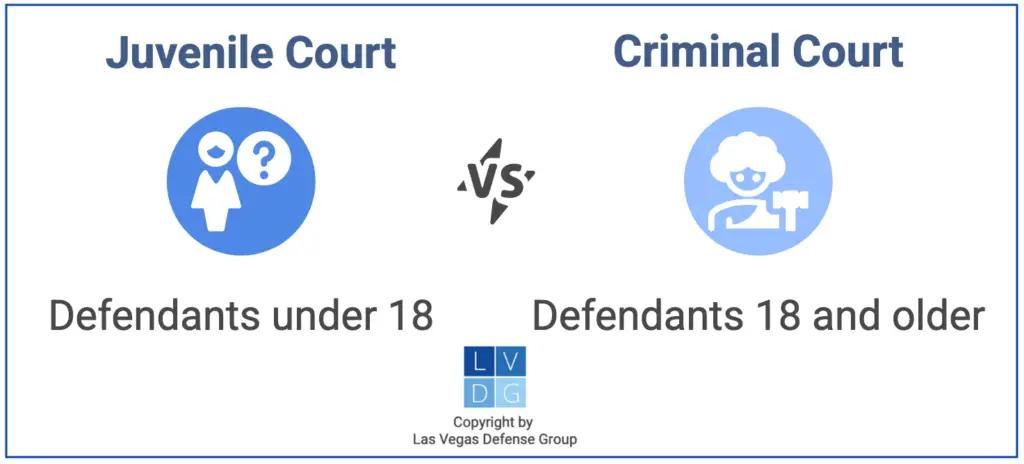
A person who allegedly committed a fake-ID offense before turning 18 will generally be handled in Nevada juvenile court. A child who was at least 14 and is accused of conduct that would constitute a felony if committed by an adult may, in qualifying circumstances, be certified for prosecution as an adult. Ordinary, misdemeanor fake-ID allegations generally remain in juvenile court.6
Possible juvenile dispositions include probation, community service, counseling, restitution, and other court-ordered conditions. The exact outcome depends on the charge, the child’s record, and the facts. A juvenile case may also affect school discipline, employment, or other opportunities, although those consequences are not automatic.
Fighting Fake ID Charges
Here at Las Vegas Defense Group – Criminal & DUI Attorneys, I have represented countless people charged with driver’s license related offenses. In my experience, the following five defenses have proven very effective with Nevada prosecutors, judges, and juries in getting these cases reduced or dismissed.
1. You did not knowingly possess or control the ID
The ID may have belonged to a roommate, or someone may have left it in your home or vehicle without your knowledge. Depending on the statute charged, the state may need to establish knowing possession, control, or the specific unlawful purpose required by the statute.
Lack of knowledge is particularly relevant to whether you actually or constructively possessed the item.
2. You did not have the purpose required by the statute
Some fake-ID crimes require proof of a particular purpose. For example, NRS 205.465 requires possession for the purpose of establishing a false status or identity. An ID kept as a prop, joke, or artwork may not satisfy that element, although another statute could still apply to an altered or counterfeit license.
3. The police conducted an unlawful search
If police obtained the ID or related evidence through an unconstitutional search or seizure, I can ask the judge to suppress that evidence. If the judge agrees, the prosecutor may then have to reduce or dismiss the charge for lack of proof.
4. The license was genuine
Police, casino personnel, or store employees may mistakenly believe that a genuine license has been altered or counterfeited. DMV records, expert examination, or other evidence may establish that the credential was valid.
5. There was no unlawful intent
As mentioned above, possessing the personal identifying information of five or more people can create a rebuttable inference that it was intended for unlawful use, but it does not establish automatic guilt.7
I may rebut the inference by showing that the people consented, the information was held for a lawful purpose, or you did not know it was present. The prosecution still must prove every element beyond a reasonable doubt.
What Nevada Driver’s Licenses Look Like
Nevada issues standard and Real ID-compliant credentials. A Real ID has a star marking, while a standard card is marked as not valid for official federal purposes. Because designs and security features can change, the Nevada DMV is the best source for current examples.8
Nevada also issues driver authorization cards to qualifying residents who cannot meet the proof-of-identity requirements for a standard license. This is a lawful driving credential, but it may not be used as proof of identity for other purposes.9

Frequently Asked Questions
Is having a fake driver’s license always a felony in Nevada?
No. The offense may be a misdemeanor, gross misdemeanor, category E felony, category C felony, or category B felony. The classification depends on whether the person made, possessed, used, sold, or transferred the ID and what the person intended to accomplish.
In my experience, many people assume every fake ID is a felony. Often, the first issue is whether the case involves only false proof of age or an alleged plan to establish a false identity or commit another crime.
Can I be arrested for using someone else’s real driver’s license?
Yes. NRS 483.530 makes it a misdemeanor to display or represent another person’s license as your own. The person who knowingly lends the license may also face a misdemeanor charge.
I often tell clients that an authentic card can still create a criminal case when it belongs to someone else. The state does not have to prove that the physical license was counterfeit.
Is using a fake ID to buy alcohol a felony?
Usually not when the sole purpose is to misrepresent age. An under-21 person who uses a fake ID to obtain alcohol generally commits a misdemeanor under NRS 205.460. More serious charges may apply if the ID was sold, transferred, or used for identity theft or another crime.
From what I have seen, the surrounding facts matter. Using an ID at a bar is usually treated differently from using it to open a bank account, obtain credit, or impersonate another person.
Can I be charged for making or selling fake IDs?
Yes. Making a fake ID for an under-21 person to obtain alcohol or gamble is a misdemeanor under NRS 205.460, while selling or giving that type of ID to the under-21 person is a gross misdemeanor. Selling or transferring a document to establish a false identity or status is generally a category C felony under NRS 205.465.
Distribution allegations are treated more seriously than a single instance of personal possession. Messages, payment records, printers, and card-making equipment can become important evidence.
Can a fake ID conviction be sealed in Nevada?
Nevada generally allows an ordinary misdemeanor conviction to be sealed after one year, a gross misdemeanor or category E felony after two years, and a category B, C, or D felony after five years.
The statutory period generally runs from release from actual custody or discharge from parole or probation, whichever occurs later; for many misdemeanors, it runs from release from custody or the end of a suspended sentence, whichever occurs later.
A dismissed case may generally be sealed without a waiting period, subject to the procedural requirements of NRS 179.255.10
Eligibility depends on the exact conviction, the applicable statutory starting point, and your complete record. Other outstanding requirements may also affect the petition.
Will a fake ID charge suspend my driver’s license?
It depends. A court or the DMV may impose consequences when an applicable statute authorizes them. Fraud in obtaining a Nevada driver’s license can lead to the DMV cancelling it.
With these types of cases I handle both the criminal charge and any related DMV administrative matter.
Recent Fake-ID and Identity Theft Cases in Nevada
- Romanian national indicted in Las Vegas case involving counterfeit passport and driver’s license (U.S. Attorney’s Office, District of Nevada)
- Las Vegas man sentenced for unemployment-benefits fraud and identity theft (U.S. Attorney’s Office, District of Nevada)
- Man arrested after trying to use fake ID to purchase motorcycle (KSNV News 3)
- Suspect faces charges related to ‘forgery lab’ inside Strip hotel room (Las Vegas Review-Journal)
- Carson City arrest for fake ID lab, drugs (KOLO News 8)
- A closer look at voter ID issues in the Nevada GOP caucus (Las Vegas Weekly)
Additional Resources
- Nevada Identity Theft Program
- Identity Theft Laws in Nevada
- Identity Theft Central
- Recovering from Identity Theft
Legal References
- NRS 483.530; NRS 205.460; NRS 205.463; NRS 205.465.
- NRS 483.530.
- NRS 205.460.
- NRS 205.463; NRS 205.465.
- NRS 205.460; NRS 205.463; NRS 205.465; NRS 483.530; NRS 193.150; NRS 193.140; NRS 193.130; NRS 176.033.
- NRS 62B.390.
- NRS 205.463(5); NRS 205.465(6).
- Nevada DMV, Real ID.
- Nevada DMV, Driver Authorization Cards; NRS 483.291.
- NRS 179.245; NRS 179.255.