





Quick summary
Yes. The Nevada DMV can suspend, restrict or cancel your driver’s license if a medical condition makes driving unsafe, but it usually asks for a doctor’s report or new tests first, and you can ask for a hearing.
- Your duty to report: You must tell the DMV about certain conditions, such as recent seizures, blackouts or serious heart problems, when you apply for or renew your license.
- Who else reports: Nevada doctors must report a patient only for epilepsy that severely impairs driving. Other reports from doctors, family members and police are allowed but not required.
- Deadlines: You have 15 days to take a requested exam, and a hearing is held within 20 days of your request.
Example: Linda’s adult son worries about her driving after a fender bender in Henderson. He sends the DMV a request to re-examine her, but includes no doctor’s affidavit and no police report. His request doesn’t meet the requirements of Nevada law, so it isn’t a valid basis for a re-exam.
In this article, our Las Vegas defense attorneys answer 7 common questions about medical license suspensions in Nevada:
- 1. What medical conditions must I report?
- 2. Does my doctor have to report me?
- 3. Can a family member report me?
- 4. What happens after the DMV gets a report?
- 5. What restrictions can go on my license?
- 6. How do I fight a medical suspension?
- 7. FAQ
1. What medical conditions must I report?
When you apply for or renew a Nevada driver’s license, you must send the DMV a written medical report if you have any of these conditions:1
- Lapse of consciousness in the last 3 years from a condition that can cause one, such as epilepsy, diabetes, frequent fainting or dizzy spells from a major medical problem, or a major head injury.
- A heart or blood-vessel problem in the last 3 years that may affect safe driving, such as a heart attack, angina or a blood clot.
- A mental, nervous or psychiatric disorder likely to affect safe driving, for example schizophrenia or a severe mood disorder.
- A muscle, joint, bone or nerve disease, such as arthritis, that may affect your control of the car.
- Three DUI convictions in the last 4 years.
- Vision worse than 20/40 in both eyes, even with glasses or contacts.
- Any other medical problem the DMV examiner has good cause to believe may affect safe driving.
These categories are broad. Depending on how severe it is, a psychiatric condition such as bipolar disorder or mania, schizoaffective disorder, schizophrenia or another psychotic disorder, severe depression or anxiety, or a personality disorder may need to be reported if it is likely to affect your driving. Physical limits count too: hearing loss, limited mobility or being unable to reach the pedals often leads to a restriction, such as a hearing aid, an adaptive device or a seat cushion, rather than a suspension (see the restriction codes in section 5).
The DMV also asks about these conditions on every license application and renewal form, so your own answers are often how the DMV first learns of a condition. For more on how age and health affect driving privileges, see our page on Nevada laws for elderly drivers.
2. Does my doctor have to report me?
Usually not. Under NRS 629.047, a Nevada doctor or advanced practice registered nurse (APRN) must report you to the DMV in only one situation: they decide that your epilepsy severely impairs your ability to drive safely. In that case, they must warn you, sign a statement saying they did, and send a copy to the DMV within 15 days.2
For other conditions, doctors may report you, but Nevada law doesn’t require them to. Even for epilepsy, a doctor or APRN “is not required to notify the Department” outside that one situation.3
Doctors, psychologists, optometrists, police, courts and health agencies may still send the DMV information about you. The DMV treats that information as true unless you show it isn’t.4 Doctors use the DMV’s Confidential Physician’s Report (form DLD-7). To learn more about seizures specifically, see Who reports seizures to the DMV in Nevada?

3. Can a family member report me?
Yes, but only within strict limits. Under NRS 483.363, a relative can ask the DMV to re-examine you only if all of these are true:5
- They are 18 or older.
- They are your spouse or a relative within the third degree (for example, a parent, child, sibling, grandparent, grandchild, aunt, uncle, niece or nephew).
- They believe, reasonably and in good faith, that you can’t drive safely.
- Their concern is backed by a doctor’s or APRN’s affidavit agreeing you should be examined, or by a police investigation.
The report must include the relative’s name, relationship, address, phone number and signature. It is kept confidential, but it must be released to you if you ask. No one can file more than one report about the same driver in 12 months.6 Relatives use the DMV’s Request for Re-Evaluation (form DLD-23a).
If a report about you doesn’t meet these rules, that is often the first thing to challenge.
4. What happens after the DMV gets a report?
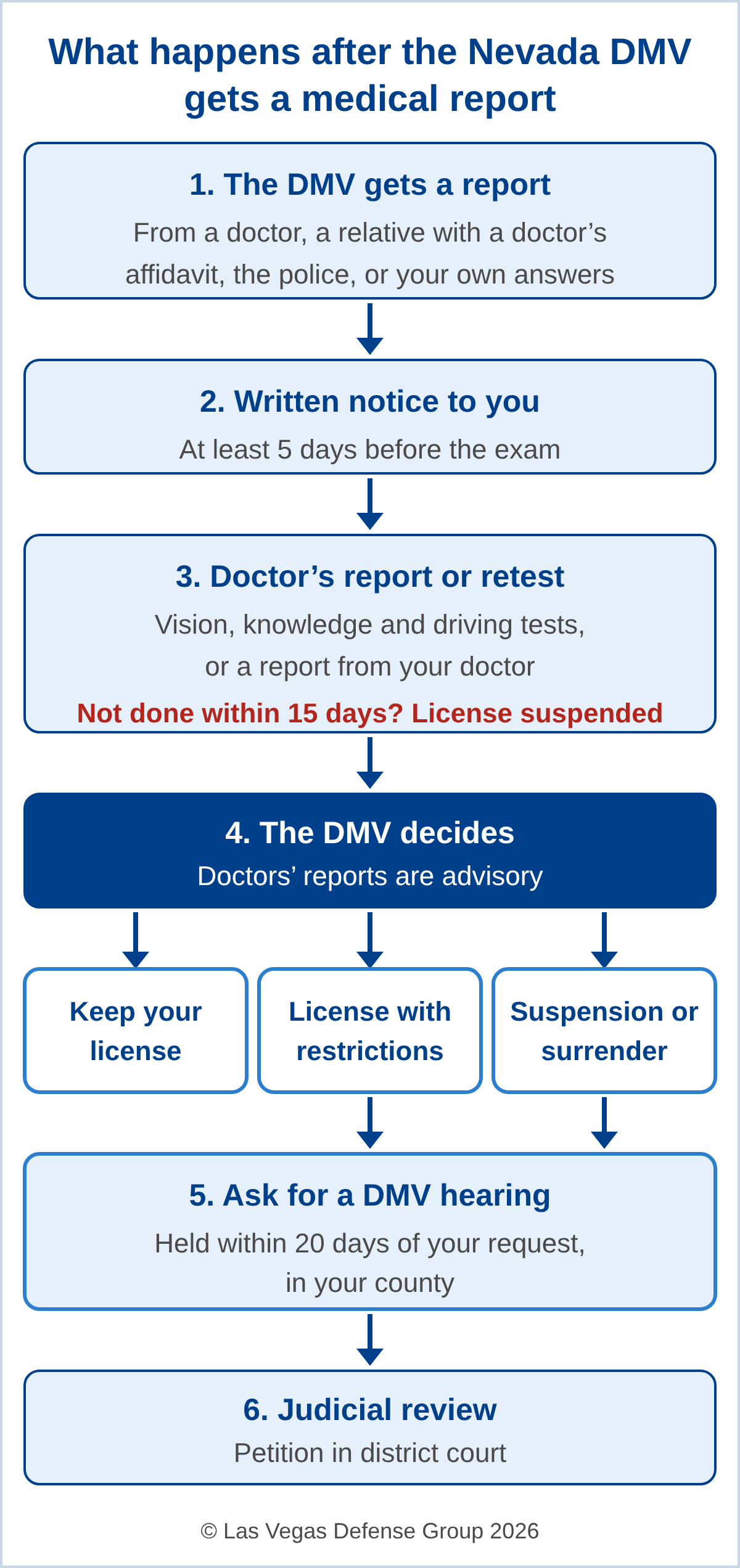
The DMV must give you written notice at least 5 days ahead. It can then require you to retake all or part of the regular license exam: the vision, knowledge and driving tests.7 It can also ask for a medical report from your own doctor, due within 30 days of your exam. Those reports are advisory: the DMV, not your doctor, makes the final decision.8
Your own words can start this process. In State, Department of Motor Vehicles v. Miles, a driver mentioned to a DMV clerk that he had diabetes and multiple sclerosis. The Nevada Supreme Court held that the DMV could then demand a physician’s report, calling that “both reasonable and within the purview of the statute and regulations,” and ruled for the DMV, which had revoked his license when he refused.9
The 15-day deadlines
If you don’t take a requested exam within 15 days, the DMV will suspend your license.10 If the DMV decides you can’t drive safely, it may let you surrender your license voluntarily instead. You then get a free ID card, and you can apply to get your license back when you have medical evidence that you can drive safely. If you don’t surrender it within 15 days of the DMV’s request, the DMV suspends your license.11
One thing we’ve found: answering the DMV quickly and completely is often the simplest way to keep a medical review from becoming a suspension.
Example: When renewing his license in Reno, Marcus mentions that he had fainting spells last year. The DMV asks him for a doctor’s report. If he doesn’t get the exam done within 15 days of the request, the DMV will suspend his license. If he does, the DMV decides whether he keeps his license, gets restrictions or must stop driving for now.
5. What restrictions can go on my license?
Restriction 7 means you must send the DMV a yearly medical letter. It goes on the license of a driver who has had seizures or episodes of altered consciousness in the last 3 years, or whose doctor says a yearly exam is needed. Nevada’s medical restriction codes are:12
| Code | Restriction |
|---|---|
| B | Corrective lenses |
| C | Mechanical or adaptive device |
| D | Prosthetic aid |
| F | Outside mirrors |
| G | Daylight driving only |
| JB | Driving test every 6 months |
| JC | Vision exam every 6 months |
| JF | Must have wink mirrors |
| JK | Left-foot accelerator |
| JT | Speed not to exceed 45 mph |
| JV | Nevada medical waiver |
| V | Federal medical waiver |
| 1 | Telescopic device |
| 2 | Hearing aid |
| 4 | Grip on steering wheel or power steering |
| 5 | Directional signals |
| 6 | Yearly vision exam |
| 7 | Yearly medical letter |
| 8 | Yearly driving test |
| 9 | Seat cushion or automatic seat |
The DMV can also add any other restriction your doctor recommends. Adding a medical restriction costs nothing.13 But take yearly restrictions seriously: if you miss a required yearly vision exam, medical exam or driving test, the DMV will cancel your license.14
Separately, you can ask your doctor to note one medical condition on the DLD-7 form so that an indicator is printed on your license or ID card to alert police and medical personnel. This is optional.
6. How do I fight a medical suspension?
You have the right to a hearing. Under NRS 483.470, when the DMV suspends a license because it believes the driver is physically or mentally unable to drive, it must, on request, hold a hearing “as early as practical within 20 days after receipt of the request in the county wherein the person resides.”15 The same right applies if the DMV suspends you for breaking a restriction.
Hearings are run by the DMV’s Office of Administrative Hearings, in Las Vegas (2621 E. Sahara Ave., 702-486-4940) and Carson City (555 Wright Way, 775-684-4574). You can request a hearing by email at [email protected] with your full name, license number, DMV file number, mailing address and phone number. See also how to request a DMV hearing in Nevada.
What the hearing is like
- An administrative law judge decides the case.
- Witnesses testify under oath and can be cross-examined.
- The judge may subpoena witnesses or evidence and consider settlement offers.
- You can bring your own witnesses, such as your doctor, to testify that you can drive safely.
- There is no fee, the hearing is open to the public and recorded on audio, and casual but respectful dress is fine.
In our experience, a current, detailed report from your treating doctor is often the most persuasive evidence at a medical-suspension hearing. We can also cross-examine the people whose reports led to the suspension, check whether the DMV followed its own rules, and in some cases resolve the matter with the DMV before a hearing. For more, see our page on Nevada DMV hearings.
If you lose the hearing
You can ask a district court to review the decision under Nevada’s Administrative Procedure Act (NRS chapter 233B). Court filing fees apply.16 Don’t drive while your license is suspended: that is a separate crime, explained on our page about driving on a suspended license in Nevada.
7. FAQ
Do older drivers have to retake the driving test in Nevada?
Not because of age alone. Drivers 65 and older get 4-year licenses instead of 8-year licenses. Drivers 71 and older who renew online or by mail must send a doctor’s statement that they can drive safely and a vision report.17
Can I get my license back after surrendering it?
Yes. You can apply for reinstatement once you can give the DMV medical evidence that you are able to drive safely.18
Does a medical restriction cost extra?
No. The DMV charges no fee to add a restriction because of a medical condition.19
Does winning the DMV hearing end a criminal case?
No. If your suspension followed a crash, any criminal charges or civil lawsuit are separate from the DMV hearing, and the outcome of one doesn’t decide the others.
What else can get my license suspended in Nevada?
Many non-medical problems can also cost you your license, including:20
- A DUI arrest where you fail or refuse a breath or blood test
- 12 or more demerit points in 12 months (6 months the first time)
- A graffiti conviction (6 months to 2 years for adults)
- A street racing (speed contest) conviction (6 months to 2 years)
- Unpaid child support, if you don’t agree to a repayment plan
- Letting your SR-22 proof of insurance lapse during the 3 years after a revoked license is reinstated
- A crash causing injury or more than $750 in property damage, if you have no insurance and don’t post the security the DMV sets
- Missing a court date or not paying a traffic fine
- For drivers under 18: habitual truancy, alcohol or drug offenses, firearm offenses or graffiti
Talk to a Las Vegas license suspension lawyer
If the Nevada DMV has asked you for a medical report, ordered a re-exam, or suspended your license, our Las Vegas criminal defense attorneys can help you answer on time and request a hearing. Call 702-DEFENSE (702-333-3673) or contact us for a free consultation.
Legal references:
- NAC 483.330: a person with one of the listed ailments “who is applying for or renewing a driver’s license or who is requested by the Department to obtain a medical examination, must submit a written medical report describing the ailment and its effect on the person’s ability to operate a motor vehicle safely.” “The Department will not charge a fee to any person who is required to add a restriction to his or her license as a result of a medical condition.”
- NRS 629.047(1): if a physician or APRN “determines that, in his or her professional judgment, a patient’s epilepsy severely impairs the ability of the patient to safely operate a motor vehicle,” they must inform the patient, sign a statement, and “Within 15 days after making such a determination, provide to the Department a copy of the statement.”
- NRS 629.047(2): “Except as otherwise provided in subsection 1, a physician or an advanced practice registered nurse is not required to notify the Department about a patient who has been diagnosed with epilepsy.”
- NAC 483.300(2): “Upon receipt of such information, the Department will act upon it as if it were true, unless and until sufficient proof is presented to indicate the original information was untruthful.”
- NRS 483.363(1), (2)(b): “A person who is 18 years of age or older may file with the Department a report requesting that the Department examine a licensee who: (a) Is related to the person filing the report within the third degree of consanguinity or who is the spouse of the person filing the report; and (b) The person filing the report reasonably and in good faith believes cannot safely operate a motor vehicle.” The basis must be corroborated “by an affidavit from a physician or an advanced practice registered nurse,” or be “An investigation by a law enforcement officer.”
- NRS 483.363(2): the report must “Be kept confidential, except as otherwise provided in NRS 239.0115 and except that the report must be released upon request of the licensee or an order of a court of competent jurisdiction.” “No person may file more than one report concerning the same licensee within a 12-month period.”
- NRS 483.367(1): “the Department shall, upon written notice to the licensee of at least 5 days, require the licensee to submit to all or part of the regular examination set forth in NRS 483.330.” See also NRS 483.480(1).
- NAC 483.310(1), (3): “The report must be submitted within 30 days after the date of the physical or mental examination.” “The medical reports are advisory and are not binding on the Department.”
- State, Dep’t of Motor Vehicles & Pub. Safety v. Miles, 111 Nev. 681, 685-86, 895 P.2d 1316 (1995): “we conclude that the measures taken by the DMV were both reasonable and within the purview of the statute and regulations.”
- NAC 483.320(1): “The Department will suspend the driver’s license of any person who fails to submit to an examination within 15 days after it is requested.”
- NAC 483.320(4): “The licensee may apply for a reinstatement of the driver’s license if the licensee presents medical evidence satisfactory to the Department that he or she is physically or mentally capable of operating a motor vehicle. If the licensee fails to surrender his or her license voluntarily to the Department within 15 days after the Department requests the surrender, the Department will suspend the licensee’s driving privilege.”
- NAC 483.350(2)-(3): Restriction 7 “is placed on the driver’s license of a person who has had seizures or episodes of altered consciousness within the last 3 years or another physical or mental condition that his or her physician determines necessitates a yearly medical examination.” “The Department will place any other restriction that is not otherwise described in this section upon the driver’s license of a person if the physician of that person so recommends.”
- NAC 483.330: a person with one of the listed ailments “who is applying for or renewing a driver’s license or who is requested by the Department to obtain a medical examination, must submit a written medical report describing the ailment and its effect on the person’s ability to operate a motor vehicle safely.” “The Department will not charge a fee to any person who is required to add a restriction to his or her license as a result of a medical condition.”
- NAC 483.320(3): “If a licensee fails to comply with any restriction requiring a yearly vision examination, medical examination or driving test, or any combination thereof, the Department will cancel his or her license.”
- NRS 483.470(1)(c), (2): the Department may suspend a license without a preliminary hearing if the licensee “Is physically or mentally incompetent to drive a motor vehicle,” and on request “shall afford the person an opportunity for a hearing as early as practical within 20 days after receipt of the request in the county wherein the person resides.” See also NRS 483.360(3).
- NRS 483.520: “Any person denied a license or whose license has been cancelled, suspended or revoked by the Department is entitled to judicial review of the decision in the manner provided by chapter 233B of NRS.”
- NAC 483.043(3): a license “issued to a licensee who is 65 years of age or older on the date of issuance or renewal expires on the fourth anniversary of the birthday of the licensee.” NAC 483.430(2)(d): a holder may not renew by an alternate service transaction if “The holder is 71 years of age or older, unless he or she submits: (1) A statement from a licensed physician providing that it is the opinion of the physician that the person is physically able to operate a motor vehicle safely; and (2) A report from a licensed ophthalmologist, optometrist or physician regarding the vision of the person.”
- NAC 483.320(4): “The licensee may apply for a reinstatement of the driver’s license if the licensee presents medical evidence satisfactory to the Department that he or she is physically or mentally capable of operating a motor vehicle. If the licensee fails to surrender his or her license voluntarily to the Department within 15 days after the Department requests the surrender, the Department will suspend the licensee’s driving privilege.”
- NAC 483.330: a person with one of the listed ailments “who is applying for or renewing a driver’s license or who is requested by the Department to obtain a medical examination, must submit a written medical report describing the ailment and its effect on the person’s ability to operate a motor vehicle safely.” “The Department will not charge a fee to any person who is required to add a restriction to his or her license as a result of a medical condition.”
- NRS 484C.210: “Revocation of license, permit or privilege to drive when person fails to submit to evidentiary test or when test shows concentration of alcohol of 0.08 or more in blood or breath.” NRS 483.475(3)(a): “For the first accumulation of 12 demerit points during a 12-month period, 6 months.” NRS 206.330(7): the court shall “issue an order suspending the driver’s license of the person for not less than 6 months but not more than 2 years.” NRS 484B.653(5)(a): the court “Shall issue an order suspending the driver’s license of the person for a period of not less than 6 months but not more than 2 years.” NRS 425.510: without an approved repayment plan, “the driver’s license and motorcycle driver’s license of the person … may be subject to suspension.” NRS 483.525: “The person shall maintain proof of financial responsibility for 3 years after the date of reinstatement … If the person fails to do so, the Department shall suspend his or her license.” NRS 485.190: after a crash causing injury or “damage to the property of any one person in excess of $750,” the Department shall “suspend the license of each operator … unless the operator or owner, or both, immediately deposit security.” NRS 484A.7047(1)(b): for unpaid civil traffic penalties the court may “Order the suspension of the driver’s license of the delinquent person”; see also the Nevada DMV Office of Administrative Hearings on suspensions for “Failure to Appear/Pay Fine in Court.” NRS 62E.430 (habitual truants), 62E.630 (alcohol or controlled substances), 62E.650 (firearms) and 62E.690 (graffiti): suspension or delay of a child’s driver’s license.