







In Nevada, theft—often called larceny—means knowingly taking, controlling, converting, or obtaining another person’s property or services without legal authority. Theft can be a misdemeanor for property worth under $1,200 or a felony for $1,200 or more.1
In this article, I explain:
- what prosecutors must prove;
- the possible penalties;
- defenses that may apply;
- when a theft record may be sealed; and
- why noncitizens should get immigration advice before resolving a case.
1. What counts as theft in Nevada?
Nevada’s theft law comprises such crimes as petty larceny, grand larceny, shoplifting, embezzlement, and receiving stolen property.
A person commits theft when, without lawful authority, the person:
- knowingly controls another’s property intending to deprive the owner of it;
- makes an unauthorized transfer or conversion;
- obtains property or services through a material misrepresentation;
- keeps lost property without reasonable efforts to find the owner;
- knowingly controls stolen property; or
- obtains services without paying.2
For a basic taking charge, Nevada prosecutors must prove that:
- the property belonged to someone else,
- the defendant knowingly exercised unauthorized control, and
- the defendant intended to deprive the owner of it.3
“Deprive” includes withholding property permanently or long enough to lose a substantial part of its value or use.4
In our experience, the real fight is often about intent or permission—not whether an item physically changed hands. A borrowed phone, disputed paycheck, workplace access, or a confusing return transaction can look very different once the surrounding messages, receipts, and witness accounts are examined.
2. How serious are Nevada theft penalties?
The penalty for stealing usually depends on the fair market value of the property or services at the time of the theft, as the following table shows.5
| Value of Stolen Property | Nevada Theft Penalties |
| Less than $1,200 | Misdemeanor
|
| $1,200 to less than $5,000 | category D felony
|
| $5,000 to less than $25,000 | category C felony
|
| $25,000 to less than $100,000 | category B felony
|
| $100,000 or more | category B felony
|
The separate Nevada crime of “organized retail theft” involves taking $3,500 or more during 120 days, and it is always a category B felony. If the aggregated value of the property is less than $10,000, the penalty is one to 10 years in prison, up to $10,000 in fines, and restitution. Otherwise, the penalties is two to 15 years in prison, up to $20,000 in fines, and restitution.6
In theft cases we handle, we look at conditions, records, invoices, and resale evidence in an effort to show that the state inflated the dollar figure of the allegedly stolen items or services. We may then be able to get the charges knocked down significantly.
3. What defenses can beat a theft charge?
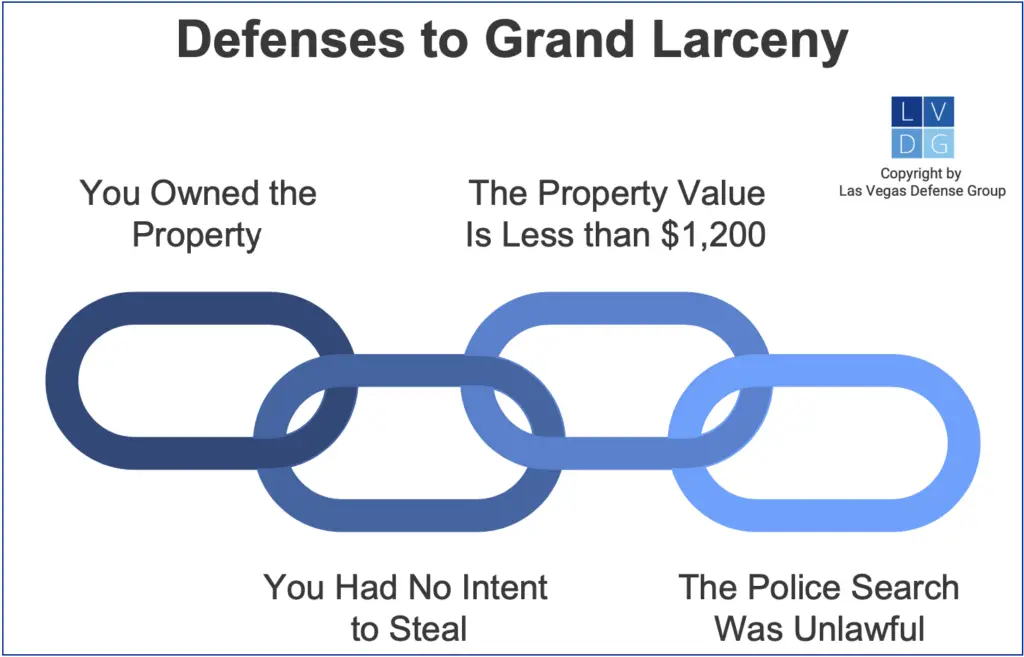
Here at Las Vegas Defense Group – Criminal & DUI Attorneys, I have represented literally thousands of people charged with theft crimes. In my experience, the following five defenses have proven very effective with prosecutors, judges, and juries in getting these charges reduced or dismissed:
- The incident was an accident. Sometimes shoppers preoccupied with their phones walk out of a store forgetting to pay.
- The property belonged solely to the defendant. People cannot steal their own property as long as no one else has an ownership interest in it.7
- There was no intent to deprive the owner. Perhaps the defendant had a genuine, good faith belief that the owner gifted them the property or allowed them to borrow it.
- The defendant was falsely accused. Perhaps someone is trying to get the defendant into trouble out of anger or revenge.
- The police arrested the wrong person. Mistaken identity cases are not uncommon, especially when police are going by grainy surveillance footage.
In these cases, I advise clients to preserve texts, emails, receipts, and return records. These may help show that there was no theft, no intent to steal, or that the property at issue is valued less than what the prosecutors claim.
4. Can a Nevada theft conviction be sealed?
In Nevada, misdemeanor theft convictions are generally eligible for a record seal one year after the case closes. For felony convictions, the wait time is usually five years.
However, if a theft charge gets dismissed through an acquittal or by the D.A. dropping the case, then defendants can pursue a record seal immediately.8
Note that the record seal process itself involves several steps and can take a year to complete. However, it is well worth doing. Having a clean background check can greatly improve job, housing, educational, and loan prospects.
5. What are the immigration consequences of a theft case?
Federal law can make a noncitizen inadmissible or removable for certain qualifying crimes involving moral turpitude or aggravated felonies.9 An aggravated felony includes a theft or receipt of stolen property offense when the term of imprisonment is at least one year.10
For me, these “crimmigration” cases have two objectives: 1) Get the best outcome in the criminal case, and 2) Do not jeopardize the defendant’s resident status.
In my opinion, every non-citizen charged with theft, even as a misdemeanor, should retain a criminal defense attorney with a strong background in immigration law. The law is in a constant state of flux, and non-citizens have to be careful not to accept a plea deal that could prevent them from remaining in the U.S.

FAQs
Is shoplifting the same as theft in Nevada?
Yes. Taking store merchandise without lawful authority can be charged as theft, and the value-based penalties in NRS 205.0835 generally apply unless a more specific statute imposes a greater penalty.
In our experience, shoplifting cases often turn on surveillance video quality, provable value, and evidence of intent. The vast majority of these cases resolve with a plea rather than a trial.
Does returning stolen property make the charge go away?
No. Returning property may affect restitution, negotiations, or sentencing, but it does not automatically undo a completed theft offense.
People should be careful not to make damaging or incriminating statements while trying to fix a situation. Apologies may be construed as an admission of guilt and can be used against defendants by prosecutors.
Can Nevada combine several thefts to make a felony?
For the crime of organized retail theft, Nevada law aggregates the value of qualifying thefts by all participants committed during a 120-day period. This way, several instances of what would ordinarily be petty larceny get charged together as one overarching felony.
When defending these cases, we may dispute the D.A.’s claims about the dates, participants, stores, and links among alleged incidents. This could result in charges being greatly reduced or even dismissed.
Can a Nevada theft charge get dismissed through diversion?
In my experience, pre-prosecution diversion is most realistic in lower-level, nonviolent cases where the person can promptly repay the loss and has limited criminal history.
Are robbery and burglary theft crimes in Nevada?
Not exactly. They are more serious.
Robbery is taking personal property from someone’s person or immediate presence by force, violence, or fear, such as holding up a cashier. Meanwhile, burglary is entering a structure, vehicle, or other covered place with the intent to commit larceny, assault, battery, or another felony while inside. A burglary charge does not require that anything was actually stolen.
The distinction matters because a shoplifting accusation may become burglary if prosecutors claim the person entered a store intending to steal, while robbery allegations depend on proof of force or fear. These cases can carry much harsher consequences than ordinary theft.
Additional Resources
For more information about shoplifting laws and related topics, refer to the following:
- National Association for Shoplifting Prevention – Provides information on the causes of shoplifting, statistics, and prevention.
- Loss Prevention Magazine – Information on retail loss prevention and shoplifting deterrence.
- What the Panic Over Shoplifting Reveals About American Crime Policy – Article about how legislators are tackling shoplifting problems, by the Marshall Project
- Cleptomaniacs And Shoplifters Anonymous, LLC (CASA) – Weekly self-help group.
Legal References
- NRS 205.0832; NRS 205.0835.
- NRS 205.0833.
- NRS 205.0832; NRS 193.017.
- NRS 205.0824.
- NRS 205.0831. NRS 205.0835. NRS 193.130; NRS 193.150. See Stephans v. State (2011) 262 P.3d 727. See also, for example, Pizarro v. State (Sept. 18, 2025) 141 Nev. Adv. Op. 44 (defendant seeking gambling diversion following 22 theft counts must show a rational connection between problem gambling and the crime).
- NRS 205.08345.
- NRS 205.0828.
- NRS 179.245. NRS 179.2445; NRS 179.245. NRS 179.255.
- 8 U.S.C. §§ 1182(a)(2)(A)(i)(I), 1227(a)(2)(A)(i)-(iii).
- 8 U.S.C. § 1101(a)(43)(G).