







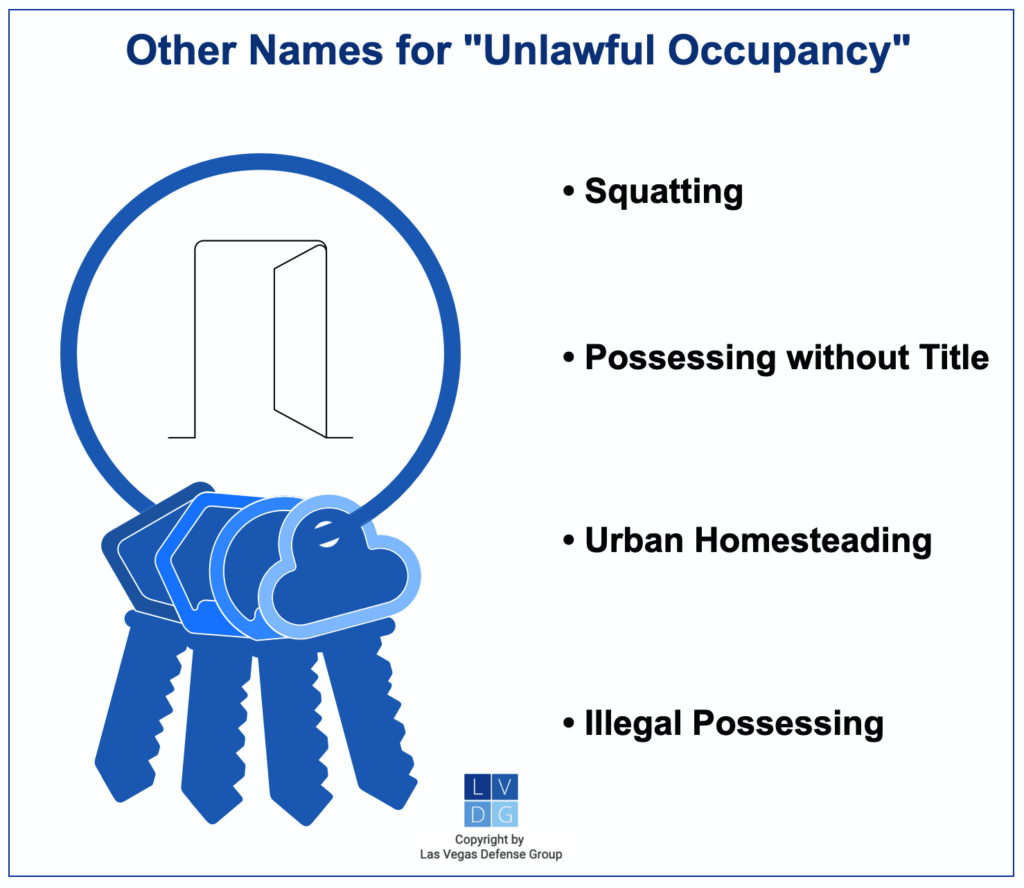
Unlawful occupancy—commonly called “squatting“—is a Nevada crime under NRS 205.0817. It occurs when you take up residence in an uninhabited or vacant dwelling knowing, or having reason to believe, that you lack permission from the owner or an authorized representative.
Penalties for Unlawful Occupancy
- First, second, or third conviction: A gross misdemeanor, carrying up to 364 days in jail and/or $2,000 in fines.
- Fourth or later conviction: A category D felony, carrying one to four years in Nevada state prison and a possible fine of up to $5,000.
Note that no break-in is required for an NRS 205.0817 conviction. Moving into a vacant home without permission can qualify as unlawful occupancy even if you entered through an unlocked door.1
What is “unlawful occupancy”?
For you to be convicted of unlawful occupancy in Nevada, prosecutors must prove beyond a reasonable doubt these two elements:
- You took up residence in an uninhabited or vacant dwelling; and
- You knew, or had reason to believe, that you lacked permission from the owner or the owner’s authorized representative.
A dwelling is a structure, or part of a structure, designed or intended for use as a residence or sleeping place. Simply being on someone else’s property is not enough to establish unlawful occupancy: The prosecution must prove that you took up residence there.2
How does a lease affect the case?
NRS 205.0817 creates a presumption that you knew you lacked permission unless you provide a written rental agreement that meets both requirements:
- It is notarized or signed by an authorized agent of the owner who held a Nevada property-management permit when signing; and
- It includes the current address and telephone number of the owner or the owner’s authorized representative.
An ordinary owner-signed lease that is not notarized does not, by itself, satisfy this specific exception to the presumption. However, it may still be important evidence that you had permission to live there.
The statute also contains a separate presumption that you knew you lacked permission if you have at least two prior convictions of housebreaking, unlawful occupancy, or lesser included or related offenses, or a combination of those offenses, arising from the same set of facts.3
Note that these presumptions do not automatically establish guilt. Under Nevada’s rules for criminal cases, the jury is not required to accept a presumed fact against you. The prosecution still must prove the necessary elements beyond a reasonable doubt.4
When preparing a defense, we look beyond whether a lease has a notary stamp. Text messages, rent receipts, emails, and the circumstances in which you received the keys may help show permission or explain why you believed you could live there. We use that evidence to challenge the prosecution’s claim that you knowingly moved in without authorization.
How do I fight the charges?
Here at Las Vegas Defense Group – Criminal & DUI Attorneys, we have represented many people charged with property crimes such as unlawful occupancy. In our experience, the following four defenses have proven very effective with prosecutors, judges, and juries in getting NRS 205.0817 charges reduced or dismissed.
- You had permission: The owner or an authorized representative allowed you to live in the dwelling.
- You reasonably believed you had permission: For example, someone posing as a legitimate landlord may have deceived you, and the circumstances gave you no reason to believe the rental was unauthorized.
- You did not take up residence: Even if you trespassed, entering or visiting the property does not necessarily mean you lived there.
- The property did not qualify: The prosecution cannot establish that it was an uninhabited or vacant dwelling. Whether a structure qualifies depends on its intended use, not simply whether someone calls it a commercial building.
For the fourth defense, a residential apartment inside a commercial building may still qualify as a dwelling. The question is whether the structure or relevant portion was designed or intended as a residence or sleeping place.5
Evidence we rely on may include surveillance footage, phone location records, witness statements, rental listings, payment records, and communications with the person who offered you the property. Evidence placing you at an address does not necessarily prove that you took up residence there or knew you lacked permission.
Our approach is to test the accusation against the full record. If police relied on a neighbor’s assumptions or ignored messages showing a rental arrangement, we bring those gaps to the prosecutor’s attention. Our goal is to build the strongest available case for dismissal or a reduction of the charges.

How is unlawful occupancy different from housebreaking?
Unlawful occupancy involves taking up residence in an uninhabited or vacant dwelling with knowledge or reason to believe that the residency is unauthorized. It does not require forcible entry.
In contrast, housebreaking in Nevada involves forcibly entering an uninhabited or vacant dwelling, knowing or having reason to believe that the entry is unauthorized, with the intent to:
- Take up residence there yourself; or
- Provide a place for someone else to reside.
You can therefore commit housebreaking even if nobody ultimately moves in. Under NRS 205.0813, forcible entry includes physical force that damages the structure or changing or manipulating a lock to gain access. The penalties are as follows:
- First housebreaking conviction: A gross misdemeanor carrying up to 364 days in jail and/or $2,000 in fines.
- Second or subsequent housebreaking conviction: A category D felony carrying one to four years in prison and a possible fine of up to $5,000.
- Three or more prior housebreaking convictions: Upon a new housebreaking conviction, the court cannot grant probation or suspend the sentence.6
We examine how entry actually occurred and what evidence shows the person’s intent at that time. A damaged door does not, by itself, establish who damaged it or why someone entered the property. Those details can be critical when challenging a housebreaking charge.
What civil consequences can I face?
An owner may pursue civil proceedings to recover possession of a property even if the occupant is never charged with or convicted of unlawful occupancy. Nevada provides specific procedures for removing unauthorized occupants, including procedures under NRS 40.412 and NRS 40.414 when their requirements are met.
Depending on the facts, an owner may also seek compensation for damage or other legally recoverable losses. A civil claim and a criminal prosecution are separate matters: Winning one does not automatically resolve the other.7
We encourage clients to bring us every notice, court paper, rental document, and message connected with the property. These records can help us understand how the dispute began and identify evidence relevant to the criminal defense. If a separate civil response is needed, it is important to address that process and its deadlines as well.

Frequently Asked Questions
Can I be charged with squatting if I never broke into the home?
Yes. Unlawful occupancy does not require a break-in. Moving into an uninhabited or vacant dwelling can violate NRS 205.0817 if you know, or have reason to believe, that you lack permission to reside there.
When reviewing these cases, we focus on both permission and residency. An unlocked door does not authorize someone to move in, but evidence that you entered the home does not necessarily prove you lived there.
Does having no written lease automatically make me guilty?
No. Nevada law creates a presumption when you cannot provide a rental agreement meeting the statute’s requirements, but that does not automatically establish guilt. The jury does not have to accept the presumption, and the prosecution must still prove the elements of the offense beyond a reasonable doubt.
We look for other evidence explaining your right to be there, including messages from the owner, payment records, and witnesses to an agreement. A paperwork problem should not end the investigation into whether you actually had permission.
What if I paid rent to someone who turned out to be a scammer?
A rental scam may support a defense if you reasonably believed the person could authorize your residency. Paying rent is relevant, but it does not automatically defeat a charge. The circumstances must be examined to determine whether you knew or had reason to believe the arrangement was unauthorized.
We would review the listing, lease, payment trail, and messages with the supposed landlord. These records can help show that you were deceived rather than knowingly occupying someone else’s home without permission.
Is falling behind on rent the same as unlawful occupancy?
No. A tenant who moved in with permission does not automatically commit unlawful occupancy by missing rent payments. Nonpayment generally involves landlord-tenant eviction procedures. A prosecution under NRS 205.0817 still requires proof of the elements of that particular crime.
We examine how the tenancy began and what the owner authorized. A later disagreement over rent does not, by itself, prove that the original move-in was unauthorized.
Can I return after the owner has removed me?
Returning can lead to a separate charge of unlawful reentry under NRS 205.082. This law applies when an owner recovered possession from you under NRS 40.412 or NRS 40.414 and you reenter without court authority or the owner’s permission. Unlawful reentry is a gross misdemeanor.
We advise clients to have the removal paperwork reviewed before returning, even to collect belongings. If you believe the removal was improper, seek relief through the appropriate legal process rather than entering on your own.
Additional Resources
If you are experiencing homelessness in Nevada, the following organizations may help:
- U.S. Department of Housing and Urban Development (HUD) – Housing assistance information and local resources.
- HELP of Southern Nevada – Housing assistance and supportive services.
- Salvation Army of Southern Nevada – Shelter and services for people experiencing homelessness.
- Nevada Homeless Alliance – Connections to housing and community resources.
- Help Hope Home – Information about shelters and other assistance in Southern Nevada.
Legal References
- NRS 205.0817(1), (3); NRS 193.140; NRS 193.130(2)(d).
- NRS 205.081; NRS 205.0817(1).
- NRS 205.0817(2)–(4). Subsection (4) provides:
A person who is accused of unlawful occupancy pursuant to subsection 1 and has previously been convicted two times of housebreaking, unlawful occupancy or any lesser included or related offense, or any combination thereof, arising from the same set of facts is presumed to have obtained residency of the dwelling with the knowledge that:
(a) Any asserted lease is invalid; and
(b) Neither the owner nor an authorized representative of the owner permitted the residency.
- NRS 47.230 (presumptions against an accused in criminal proceedings).
- NRS 205.081; NRS 205.0817.
- NRS 205.0813; NRS 193.140; NRS 193.130(2)(d). See also Austin v. State (Nev. App. 2026) 587 P.3d 826 (holding that an attached garage is part of a dwelling for purposes of Nevada’s home invasion statute).
- NRS 40.412; NRS 40.414; NRS 40.416; NRS 40.253; NRS 205.082; Squatters & Removals, Civil Law Self-Help Center.