







Under NRS 484B.653, reckless driving is typically a misdemeanor carrying up to six months in jail. However, if you caused someone to die or sustain substantial bodily harm, then reckless driving is prosecuted as a category B felony carrying:
- 1 to 6 years in prison and
- a fine of $2,000 to $5,000.
However, the maximum prison term for felony reckless driving becomes 10 years if either:
- you were speeding by 50 mph or more over the limit, or
- you were in a pedestrian safety zone, a school zone, or a school crossing zone.
Depending on the case, the Nevada DMV could temporarily suspend your driver’s license as well.1
In this article I discuss what you need to know about felony reckless driving laws in Nevada. Also listen to our informative podcast:
What qualifies as reckless driving?
There are many types of reckless driving in Nevada, the most common of which is “driving in willful or wanton disregard for the safety of people or property.” Examples of reckless driving may include:
- speeding significantly over the posted limit, especially on city streets;
- continuously running red lights; or
- hitting shoulders or medians while making abrupt U-turns.
Many reckless driving incidents I see occur during bouts of road rage where motorists are trying to get back at another driver for cutting them off.
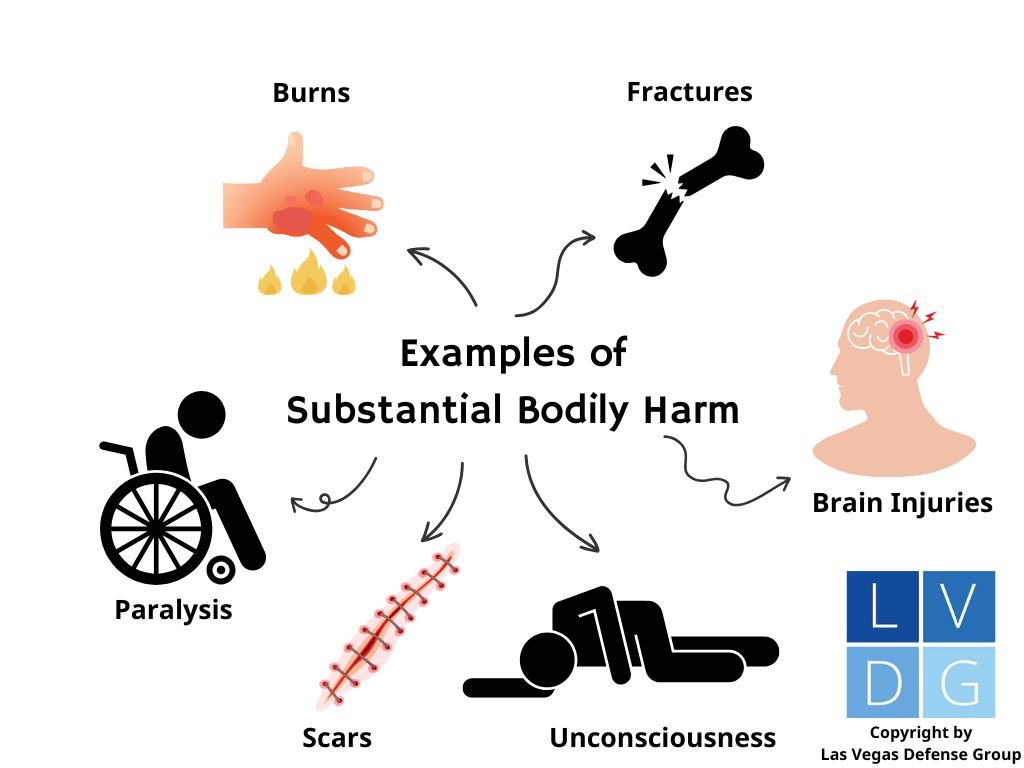
Remember, reckless driving is charged as a felony in Nevada only if your driving caused a fatality or substantial bodily harm.2 The following graphic shows examples of injuries that qualify:
How do I fight the charges?
I have defended against thousands of reckless driving charges here at Las Vegas Defense Group – Criminal & DUI Attorneys. In my experience, the following three defenses have proven very effective with prosecutors, judges, and juries at getting these charges reduced or dismissed.
- Your driving did not cause the fatality or substantial bodily harm. Perhaps there was an “intervening factor” unrelated to you that caused the victim’s death or injuries. Examples could be another driver, a falling tree branch, or mechanical defect, or road debris. This defense could get a felony reckless driving reduced to a misdemeanor.
- The police arrested the wrong person. Perhaps another driver committed reckless driving, and police arrested you by mistake because you drove a similar looking vehicle. In these cases, we would rely on GPS records, traffic surveillance video, dashcam footage, and eyewitness testimony to show you were falsely accused.
- Your driving did not rise to the level of recklessness. What constitutes reckless driving can be subjective. Therefore, what one officer would consider a minor infraction may rank as a serious violation by another officer. If we can show the prosecutor that the officer overreacted and that nothing you did showed “wilful or wanton disregard,” your charge should be reduced to an infraction.
If someone died in your case, another potential defense is that you were acting negligently instead of recklessly. Negligence, which is the legal term for carelessness, is less blameworthy than recklessness. In this situation, the D.A. may reduce your charge down to the misdemeanor crime of vehicular manslaughter.3
Additional Resources
For more in-depth information, refer to these scholarly articles:
- Deportation and Driving: Felony DUI and Reckless Driving as Crimes of Violence following Leocal v. Ashcroft – Journal of Crime & Criminology.
- Criminal Law: Reckless Driving Is Not a Lesser Included Offense of Driving While under the Influence of Alcohol – Washburn Law Journal.
- Reckless and Careless Driving: Is There a Difference? – The Journal of Criminal Law.
- Sociodemographic, behavioral, and substance use correlates of reckless driving in the United States: Findings from a national Sample – Journal of Psychiatric Research.
- Death on the Highway: Reckless Driving as Murder – Oregon Law Review.
Legal References
- NRS 484B.653. NAC 483.510. See, for example, Aparicio v. State (Nev. 2023) ; Chadwick v. State (Nev.App. 2024) .
- NRS 0.060.
- NRS 484B.657.