




NRS 202.360 prohibits people convicted of a felony from owning or knowingly possessing a firearm in Nevada unless they have received a qualifying pardon restoring their gun rights. The ban covers convictions in Nevada, other states, and federal court.
Main Points:
- Felon in possession penalties: A category B felony, carrying 1 to 6 years in prison and a possible fine of up to $5,000.
- Multiple guns: Each firearm can support a separate charge.
- Types of guns: The ban includes loaded, unloaded, working, and broken firearms.
- No automatic expiration: Finishing your sentence or staying out of trouble does not end the ban. A record seal does not restore gun rights.1
When we fight these cases, we review the conviction records, who actually controlled the gun, and how police found it. A gun discovered near you does not, by itself, prove that you knowingly possessed it.
In this article, our Las Vegas criminal defense attorneys explain the following key issues regarding Nevada “felon with a firearm” laws:
- 1. Elements and Penalties
- 2. Wobblers and Gross Misdemeanors
- 3. Defenses
- 4. Misdemeanors and Other Gun Bans
- 5. Immigration Consequences
- 6. Record Seals
- 7. Pardons and Restoring Gun Rights
- 8. Federal Law
- Frequently Asked Questions
1. Elements and Penalties
To prove a felon in possession charge under NRS 202.360, Nevada prosecutors must establish beyond a reasonable doubt the following two elements:
- You had a qualifying felony conviction (which includes old or non-violent convictions, not just recent or violent ones); and
- You owned a firearm or knowingly had one in your possession, custody, or control.2
Being a felon in possession of a firearm is a category B felony, carrying one to six years in Nevada State Prison and a possible fine of up to $5,000. Depending on the case, the judge may grant probation instead of prison.
Types of Possession
There are three different types of firearm possession, all of which are unlawful if you are a felon:
- Actual possession: You knowingly have direct physical control of the gun, such as holding it or carrying it in a holster.
- Constructive possession: You knowingly exercise control over the gun, even without holding it. For example, you keep a gun in a drawer for your use.
- Joint possession: Two or more people share knowing control of the same gun.
Being near a gun is not enough. Police must connect you to knowing possession or control. A passenger does not automatically possess every gun in the driver’s car. However, the prosecution may use witness testimony and other evidence to prove control without fingerprints or DNA.3
Unloaded, Broken, and Antique Guns
The Nevada firearm ban for felons covers handguns, rifles, and shotguns, whether loaded or unloaded, working or broken. Nevada’s gun ban for felons includes antique guns, even though federal law makes an exception for certain antiques. A gun’s age does not make it legal for a felon to possess under NRS 202.360.4
Separate Charges for Each Gun
Under NRS 202.3621, felons face separate charges for each firearm they allegedly possess. For example, possessing three guns can result in three charges, even if police find them together.5
2. Wobblers and Gross Misdemeanors
Certain Nevada attempt crimes, called wobblers, can be punished as felonies or gross misdemeanors. If the court enters a gross misdemeanor conviction instead of a felony conviction, that conviction does not trigger the felony-based gun ban under NRS 202.360. (There is an exception where non-felony convictions of domestic violence or stalking may trigger a gun ban, as discussed further below).6

3. Defenses
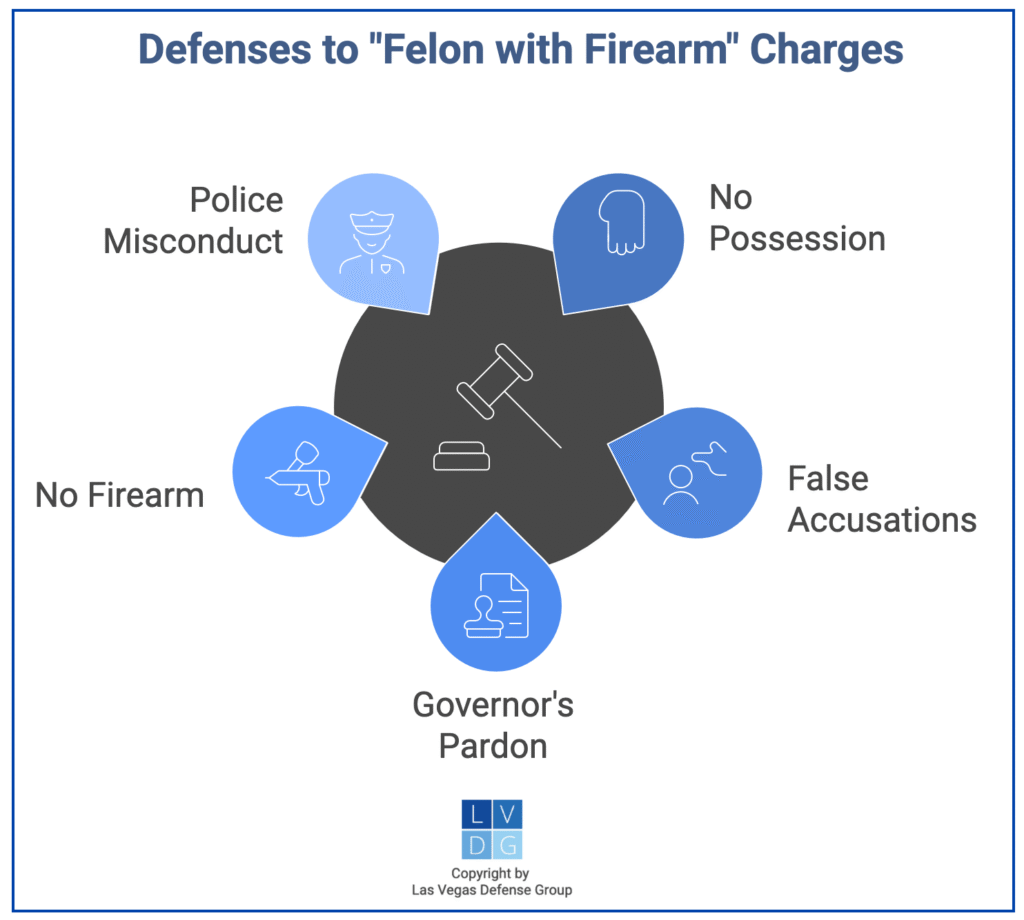
Here at Las Vegas Defense Group, we have represented literally thousands of people charged with gun crimes, including being a felon in possession. In our experience, the following five defenses have proven very effective with prosecutors, judges, and juries in getting NRS 202.360 charges reduced or dismissed.
- No knowing possession: You did not know the gun was there, or you did not control it.
- Mistaken identity or false accusations: A witness identified the wrong person or gave an unreliable account.
- No qualifying felony or an effective pardon: You had no prior qualifying convictions, or a qualifying pardon had already removed the gun ban.
- The object was not a firearm: The weapon in question did not meet the legal definition of a firearm.
- An unlawful search or seizure: Police violated your rights, and the court should exclude the evidence they unlawfully obtained.
We examine body-camera footage, witness accounts, fingerprints, DNA, and who had access to the location. As long as there is reasonable doubt, criminal charges should not stand.7
Self-Defense and the Duty to Retreat
Self-defense does not give a prohibited person general permission to keep or carry a gun. Though if you are a felon facing an imminent physical threat, you might be able to lawfully stand your ground and fight back. Nevada’s no-duty-to-retreat rule may apply only if:
- You are not the original aggressor,
- You have the right to be there, and
- You must not be actively engaged in conduct furthering criminal activity when using deadly force.
No General Exception for Work
Needing a gun for a job does not create an exception to the felon firearm ban under NRS 202.360. Nevada has separate occupational exceptions involving certain explosives and related materials used in mining, agriculture, and construction.9
4. Misdemeanors and Other Gun Bans
You do not have to be a convicted felon to lose gun rights. Under NRS 202.360, a ban is triggered by qualifying misdemeanor convictions of battery domestic violence or stalking. A ban is also triggered by:
- certain domestic violence protection orders,
- being a fugitive,
- unlawful users of controlled substances, and
- otherwise being barred under federal law.
Possessing a firearm while prohibited on these grounds is a category B felony carrying one to six years in prison and a possible fine of up to $5,000.
Note that NRS 202.360 also bans firearm possession by people with specified mental health adjudications or who are in the United States unlawfully. This is a category D felony, carrying one to four years in prison and a possible fine of up to $5,000.10
5. Immigration Consequences
A firearm conviction can put a noncitizen at risk of deportation. However, whether a particular conviction triggers removal depends on the exact offense and federal immigration law.
We recommend having a criminal defense lawyer and an immigration lawyer review any proposed plea before you accept it.11

6. Record Seals
An eligible Nevada felon-in-possession conviction generally can be sealed from your record five years after your release from actual custody or discharge from parole or probation, whichever occurs later. If the charge is dismissed, you may petition for sealing without that waiting period.
A record seal limits access to your criminal record by potential employers, but does not restore your gun rights. A sealed felony is not permission to buy, borrow, or possess a gun.12
7. Pardons and Restoring Gun Rights
A Nevada pardon granted by the Nevada Board of Pardons Commissioners forgives an offense; it does not erase or overturn the conviction. A full, unconditional pardon restores civil rights, including firearm rights. When firearm rights are restored, the official pardon document must say so explicitly.13
A pardon is discretionary, meaning approval is not guaranteed. Review the Board’s current application instructions and waiting-period rules before applying. Useful records to gather include:
- The judgment of conviction and sentence;
- Proof of completing custody, probation, or parole;
- Records of fines and restitution payments;
- Your complete criminal history;
- Evidence of rehabilitation, treatment, education, or community service; and
- An explanation of why you seek a pardon, including any employment barriers.
The Board’s rules restrict consideration in some situations, including certain cases involving ongoing sex-offender registration. Eligibility to apply does not guarantee a hearing or approval.14
The Nevada Board cannot pardon another state’s conviction or a federal conviction. Likewise, a pardon from another state does not restore gun rights in Nevada. Also, a pardon covering one conviction does not remove restrictions caused by other convictions.15
8. Federal Law
Under 18 U.S.C. § 922(g)(1), a qualifying conviction for a crime punishable by more than one year in prison generally prohibits possession of firearms or ammunition. The ordinary maximum penalty is 15 years in federal prison plus a possible fine.16
Federal Treatment of Restored Rights
Under 18 U.S.C. § 921(a)(20), certain convictions that have been expunged, set aside, pardoned, or followed by restoration of civil rights no longer trigger a gun ban. Consult an attorney to confirm whether you can lawfully possess a gun under federal law.17

Frequently Asked Questions
Can a felon own a gun in Nevada after 10 years?
The felony firearm ban does not expire after ten years. Completing your sentence or avoiding new arrests does not automatically restore gun rights. A qualifying pardon can remove the restriction caused by the pardoned conviction.
Before handling a gun, have a lawyer check the pardon document, any other convictions, and both Nevada and federal law.
Can I go to a shooting range if I do not own the gun?
If you are prohibited from possessing firearms, renting or handling a gun at a range can violate the law. Borrowing a friend’s gun is still possession even though someone else owns it.
Can I live in a house with a gun if my spouse owns it?
Sharing a home does not automatically prove firearm possession. However, knowingly controlling your spouse’s gun can be constructive possession, even if you never carry it.
Separate, locked storage that you cannot access may help show a lack of control, but it is not a guaranteed defense. Have a lawyer review the arrangement and any probation or parole conditions.
Does sealing my felony record restore my gun rights?
No. A Nevada record seal limits access to records but does not restore the right to possess firearms.
We treat record sealing and firearm rights restoration as separate issues. A sealed record or favorable background check result should not be treated as legal permission to possess a gun.
Can I be charged if the gun was unloaded or broken?
Yes. Nevada’s prohibited person law includes unloaded and inoperable firearms. Prosecutors do not have to show that the gun was ready to fire.
Are felons the only people prohibited from owning guns in Nevada?
No. Restrictions also apply to certain domestic violence and stalking convictions, qualifying protection orders, unlawful controlled substance users, fugitives, and other groups listed in Nevada and federal law.
Does a medical marijuana card restore gun rights?
No. A medical marijuana card does not remove a felony-based firearm ban or create an exception to restrictions on unlawful controlled-substance users.
Legal References
- NRS 202.360; NRS 202.3621; NRS 213.090; Nevada Board of Pardons Commissioners, Sealing Records.
- NRS 202.360(1)(b).
- Shoemaker v. State (Nev. App. 2020) No. 80375-COA (unpublished order discussing knowing possession, control, and circumstantial evidence); Woodall v. State (1981) 97 Nev. 235, 627 P.2d 402.
- NRS 202.253; NRS 202.360(4)(b); 18 U.S.C. § 921(a)(3), (16).
- NRS 202.3621 (each firearm constitutes a separate violation; added in 2023).
- NRS 193.330; NRS 202.360; NRS 176A.850.
- U.S. Const. amend. IV; Shoemaker v. State (Nev. App. 2020) No. 80375-COA; NRS 202.360.
- NRS 200.120; NRS 200.130; NRS 202.360.
- NRS 202.260; NRS 202.261; NRS 202.360.
- NRS 202.360(1)-(2); NRS 200.575(7)-(8); NRS 33.018.
- 8 U.S.C. § 1227(a)(2)(C); 18 U.S.C. § 921(a)(3), (16); NRS 202.253.
- NRS 179.245; NRS 179.255; Nevada Board of Pardons Commissioners, Sealing Records.
- NRS 213.090; Nev. Const. art. 5, § 14; Effect of a Pardon.
- NAC 213.019, 213.050, 213.055, 213.065, 213.073, 213.103, 213.107; Nevada Board of Pardons Commissioners, Application.
- Nevada Board of Pardons Commissioners, Effect of a Pardon; Nevada State Police, Point of Contact Firearms Program FAQs.
- 18 U.S.C. § 922(g)(1); 18 U.S.C. § 924(a)(8), (e); Rehaif v. United States (2019) 588 U.S. 225; Scarborough v. United States (1977) 431 U.S. 563.
- 18 U.S.C. § 921(a)(20); NRS 202.360.