


Nevada Revised Statute § 201.253 makes it a misdemeanor to knowingly cause an obscene, indecent, or immoral show, act, or performance to be performed or exhibited, or to take part in its performance or exhibition.
Penalties
- Jail: Up to six months and/or
- Fines: Up to $1,000
Defenses
- Intent: You did not act knowingly.
- No obscenity: The performance has serious literary, artistic, political, or scientific value.
- First Amendment: The show is protected free speech.
In our experience, the details of what happened onstage, what each person knew, and the context of the entire performance matter more than whether someone simply found the show offensive.
In this article, our Las Vegas criminal defense attorneys address the following key issues regarding obscene shows or performances in Nevada law:
- 1. Elements of NRS 201.253
- 2. Penalties
- 3. Defenses
- 4. Record Seals
- 5. Related Offenses
- 6. Frequently Asked Questions
1. Elements of NRS 201.253
For you to be convicted of violating NRS 201.253, prosecutors must prove beyond a reasonable doubt the following three elements:
- You caused to be performed or exhibited, or engaged in the performance or exhibition of, a show, act, or performance;
- You acted knowingly; and
- The show, act, or performance was obscene, indecent, or immoral.1
Nevada defines a “performance” to include a play, motion picture, dance, or other exhibition performed before an audience.2 For a performance to meet Nevada’s statutory definition of “obscene,” all three of the following must be true:
- An average person applying contemporary community standards would find that the performance, taken as a whole, appeals to prurient interest;
- The performance, taken as a whole, lacks serious literary, artistic, political or scientific value; and
- It depicts or describes certain sexual acts, masturbation, excretory functions, sadism or masochism in a patently offensive way, or lewdly exhibits the genitals.
Whether a performance meets that definition depends on its content and context. Nudity or poor taste alone does not establish that a show is legally obscene.3
Exemptions
- Certain public institutions: Nevada’s obscenity provisions do not apply to state or local government universities, schools, museums or libraries covered by NRS 201.237, or to people acting as employees of those organizations.
- Stagehands and projectionists: NRS 201.254 protects a qualifying stagehand or movie projectionist from criminal liability for exhibiting or possessing obscene material directly related to the show or movie, provided the person has no managerial responsibility or financial interest in the workplace beyond wages.4
Child Exploitation
NRS 201.253 specifically exempts circumstances described in NRS 200.710, the Nevada crime of using a minor to produce child sexual abuse material (or CSAM). Violating NRS 200.710 is a category A felony, carrying:
- life in Nevada State Prison with the possibility of parole,
- up to $100,000 in fines, and
- 25 years on the Sex Offender Registry (Tier II).
Whether prosecutors can bring a more serious charge than NRS 201.253 depends on the facts and the elements of that separate offense; the mere presence of a minor does not automatically establish it.

2. Penalties
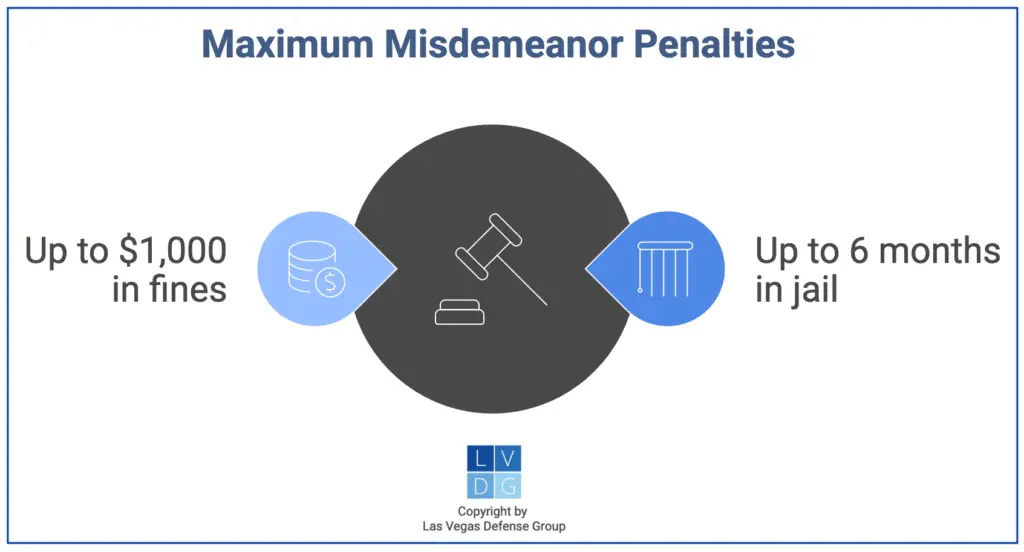
A violation of NRS 201.253 is a misdemeanor in Nevada. The possible sentence is:
- Up to six months in county jail and/or
- A fine of up to $1,000.5
NRS 201.253 does not set a higher penalty for a second or subsequent violation.6
3. Defenses
Here at Las Vegas Defense Group – Criminal & DUI Attorneys, we have represented literally thousands of people charged with crimes. In our experience, the following four defenses have proven very effective with prosecutors and judges in getting NRS 201.253 cases reduced or dismissed.
- You did not act knowingly. NRS 201.253 requires proof that you knowingly caused or engaged in the performance or exhibition. Evidence that a show changed unexpectedly may matter, depending on your role and what you knew.
- The performance was not legally obscene. Prosecutors cannot establish statutory obscenity merely by showing that some viewers were offended. The performance must satisfy Nevada’s definition when viewed as a whole.
- The charge violates free speech protections as applied to the conduct. Performances can receive First Amendment protection depending on the content, context, and specific legal theory; nudity alone does not decide the issue.
- A statutory exemption applies. For example, NRS 201.237 exempts state-controlled schools, museums, and libraries from NRS 201.253, and NRS 201.254 may protect film operators and stagehands.
In these cases, we examine the complete performance, recordings, promotional materials, witness accounts, and our client’s actual role (if any) before deciding which defense best fits the evidence.
4. Record Seals
In Nevada, you generally can petition to get an NRS 201.253 conviction sealed from your criminal record one year after the case ends. If the charge is dismissed, you can usually petition right away.7
Sealing is not automatic and takes several months of paperwork. Learn more about sealing Nevada criminal records.

5. Related Offenses
- Indecent exposure (NRS 201.220)
- Open or gross lewdness (NRS 201.210)
- Material harmful to minors (NRS 201.265)
- Obscene phone calls (NRS 201.255)
- Obscene letters (NRS 207.180)
6. Frequently Asked Questions
Is every nude show illegal in Nevada?
No. Nudity alone does not make a performance obscene under Nevada law. The statutory obscenity test considers the performance as a whole, including whether it lacks serious literary, artistic, political, or scientific value.
In our experience, descriptions of a show can leave out context that matters. We would review a recording of the full performance when one is available.
Can a performer be charged even if they did not organize the show?
Yes. NRS 201.253 covers both a person who knowingly causes a covered show or act to be performed or exhibited and a person who knowingly engages in its performance or exhibition.
We look closely at each person’s role. An organizer, performer, and employee may have different knowledge of what was planned or actually happened.
Does NRS 201.253 apply to movies as well as live shows?
Yes. Nevada’s definition of “performance” includes a motion picture, play, dance, or other exhibition performed before an audience. Whether the facts support a charge under NRS 201.253 or a different obscenity statute requires a closer look at the alleged conduct.
In our experience, it helps to identify precisely what the person is accused of doing: performing, exhibiting a movie, or distributing material.
Can a stagehand or projectionist be convicted for doing their job?
NRS 201.254 provides a specific exemption for qualifying stagehands and movie projectionists whose exhibition or possession of obscene material is directly related to their work. The exemption requires that they have no managerial responsibility or financial interest in the workplace beyond wages.
We would check the person’s job duties and compensation before relying on this exemption.
Is obscene material the same offense as an obscene performance?
No. NRS 201.253 addresses covered shows, acts, and performances. NRS 201.249 separately addresses activities involving obscene items or materials, such as certain commercial sales, distribution, or exhibitions.
Does the presence of a child automatically make an obscene show a felony?
No. NRS 201.253 excepts circumstances described in NRS 200.710, but a charge under that separate statute requires proof of its own elements. A child’s presence alone does not automatically establish a child exploitation offense.
We would examine what the child allegedly did or was asked to do, rather than assume the felony statute applies because a minor was nearby.
Legal References
- NRS 201.253 – Obscene, indecent or immoral shows, acts or performances; penalty.
Except under the circumstances described in NRS 200.710, every person who knowingly causes to be performed or exhibited, or engages in the performance or exhibition of, any obscene, indecent or immoral show, act or performance is guilty of a misdemeanor.
- NRS 201.235(5).
- NRS 201.235(4); Miller v. California (1973) 413 U.S. 15.
- NRS 201.237; NRS 201.254.
- NRS 201.253; NRS 193.150.
- NRS 201.253; NRS 200.710.
- NRS 179.245; NRS 179.255.