





NRS 203.090 makes it a misdemeanor in Nevada to willfully disturb a lawful meeting or assembly without legal authority. The law can apply to public or private gatherings.
Penalties:
- Jail: Up to 6 months; and/or
- Fines: Up to $1,000.
Defenses:
- No disturbance: Your conduct did not rise to the level of a disturbance.
- No willful conduct: The disturbance was an accident.
- Unlawful gathering: The meeting or assembly was unlawful in its character.
- Legal authority: You had legal authority to interrupt or stop the gathering.
- Speech protections: Criticizing officials or expressing an unpopular opinion does not, by itself, make you guilty of disturbing a meeting.
Statutory Text:
Every person who, without authority of law, shall willfully disturb any assembly or meeting not unlawful in its character, shall be guilty of a misdemeanor.
Our defense approach is to find out what actually happened before accepting an officer’s description of a disruption. We look for recordings, witnesses, and meeting rules that can show you were speaking lawfully, were mistaken for someone else, or did not deliberately disturb the gathering.
In this article, our Las Vegas criminal defense attorneys will address the following key issues regarding disturbing a meeting in Nevada law:
- 1. Elements of NRS 203.090
- 2. Penalties
- 3. Defenses
- 4. Immigration Consequences
- 5. Record Seals
- 6. Related Offenses
- Frequently Asked Questions
1. Elements of NRS 203.090
To convict you under NRS 203.090, Nevada prosecutors must prove beyond a reasonable doubt that you willfully disturbed a lawful meeting or assembly without legal authority.
The statute does not limit the offense to government meetings or gatherings open to the public. Depending on the circumstances, the law can apply to:
- City council and school board meetings;
- Business or community association meetings; and
- Lawful rallies and other assemblies.1
Possible examples of NRS 203.090 violations include:
- deliberately shouting over speakers so a meeting cannot proceed,
- starting a physical confrontation that interrupts the gathering, or
- intentionally disabling a microphone to stop the proceedings.
We focus on the difference between someone being annoyed by your presence and evidence that you actually disturbed the meeting. A full recording can show whether business continued normally, whether you were invited to speak, and whether someone else caused the interruption.
2. Penalties
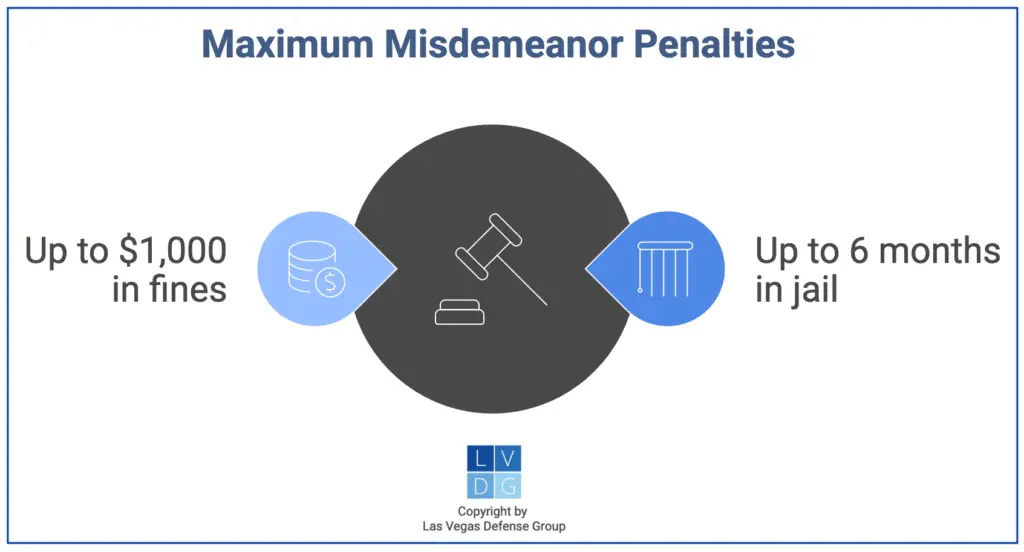
Disturbing a meeting is a Nevada misdemeanor punishable by up to six months in jail and/or up to $1,000 in fines.2
Jail is not mandatory under this statute. A negotiated resolution may involve community service, counseling, a class, or other conditions. A dismissal depends on the evidence, the prosecutor, and any required court approval.
We look first for grounds to get the charge dismissed. If negotiation offers a better path, we use weaknesses in the evidence and favorable facts about you to argue for an outcome that avoids jail and, when possible, a conviction.
3. Defenses
Here at Las Vegas Defense Group – Criminal & DUI Attorneys, we have represented literally thousands of people charged with disorderly conduct-related crimes such as disturbing a meeting. In our experience, the following five defenses have proven very effective with prosecutors and judges in getting NRS 203.090 charges dismissed.
- Protected speech: At a government meeting, officials cannot treat criticism or an unpopular viewpoint as a crime simply because they dislike it.3
- No willful disturbance: An accidental interruption may not satisfy the statute.
- No actual disturbance or mistaken identity: The evidence may fail to show that you disturbed the gathering or that you were the person responsible.
- Legal authority: For example, if you were a security officer on duty and genuinely believed there was a safety issue, it is no crime to disturb the meeting as a safety precaution.
- Unlawful gathering: NRS 203.090 does not apply if the assembly itself was unlawful in its character.
We work to preserve the full meeting video, phone recordings, police body camera footage, and witness accounts. Short clips can leave out an invitation to speak, an unclear instruction, or another person’s actions. Those missing details can be central to fighting the charge.

4. Immigration Status
A conviction under NRS 203.090 alone generally should not trigger deportation. However, immigration consequences require a separate review of your status, criminal record, and any additional charges.4
When representing a noncitizen, we make immigration consequences part of the plea review. We do not treat a “no jail” offer as the end of the analysis; we want to understand what the proposed conviction could mean for your ability to remain in the country.
5. Record Seals
For an ordinary NRS 203.090 conviction, you generally may petition to seal the record one year after your release from actual custody or the date you are no longer under a suspended sentence, whichever is later. Records do not seal themselves automatically.
If the charge is dismissed or you are acquitted, you generally may petition right away. You must still follow the applicable sealing procedure.5
We always recommend you pursue a record seal as soon as you are eligible. Even minor misdemeanors on your background check can turn off potential employers.
6. Related Offenses
Disturbing a Religious Meeting
NRS 201.270 makes it a misdemeanor to willfully disturb a gathering for religious worship through specified conduct, such as disruptive noise or behavior, or menacing, threatening, or assaulting someone there.
The conduct may occur inside the meeting place or close enough to disturb the worship. The gathering need not take place in a church, synagogue, or mosque. The ordinary maximum penalty is six months in jail and/or $1,000 in fines.6
We examine what the gathering was for, where the alleged conduct occurred, and whether the evidence shows the type of disturbance this statute requires.
Unlawful Assembly
NRS 203.060 applies when two or more people gather to commit an unlawful act and then separate without committing it or advancing toward it. It is a misdemeanor carrying up to six months in jail and/or $1,000 in fines.7
We look for evidence of what you personally agreed to do. Being near a crowd or attending a protest does not, by itself, establish that you gathered for an unlawful purpose.
Breach of the Peace
NRS 203.010 prohibits maliciously and willfully disturbing the peace or quiet of a person, family, or neighborhood through conduct such as loud or unusual noise, threats, quarreling, or fighting. It is not limited to public places. The ordinary maximum penalty is six months in jail and/or $1,000 in fines.
A different statute, NRS 203.030, makes it a misdemeanor to willfully provoke or attempt to provoke another person to breach the peace through words, signs, or gestures.8
We check the exact statute on your citation rather than relying on a general label such as disorderly conduct. That helps us identify which facts prosecutors must prove and which defense fits your charge.

Frequently Asked Questions
Can I be charged for disrupting a city council or school board meeting?
Yes, if prosecutors can prove the requirements of NRS 203.090. For example, deliberately drowning out speakers so the meeting cannot continue can support a charge. The law can also cover lawful private meetings; it is not restricted to public government gatherings.
We review the agenda, speaking rules, and recording to see whether you were using your opportunity to speak or actually preventing others from conducting the meeting.
Is swearing at a meeting automatically a crime?
No. An offensive word alone does not establish a violation of NRS 203.090. At a government meeting, the context matters: officials may enforce lawful rules that keep the meeting moving, but they cannot criminalize criticism simply because it is rude or unwelcome.
We examine whether the complaint concerns an actual interruption or just what you said. We also look at whether officials treated speakers differently because of their viewpoints.
Can everyone in a protest group be charged?
Several people who deliberately act together to disrupt a lawful meeting may face charges. However, prosecutors must establish a legal basis for each person’s responsibility. Being in the room or sharing the group’s views does not automatically make someone guilty.
We separate your actions from those of the crowd. Recordings and witnesses may show that you stayed quiet, tried to calm others, or were wrongly identified as a participant.
What if I thought it was my turn to speak?
A genuine misunderstanding may help challenge whether your conduct amounted to a willful disturbance. It is not an automatic defense, however. Believing your cause was justified also does not give you permission to deliberately stop a lawful meeting.
We look for facts that support the misunderstanding, such as a moderator calling your name, unclear instructions, or an invitation to respond. Those details can help explain your actions.
Can prosecutors convict me without a video?
Yes. Witness testimony and other evidence can support a conviction if they prove the charge beyond a reasonable doubt. Indirect evidence is not automatically insufficient, and the absence of a recording does not automatically require dismissal.
We test what each witness actually saw and heard. Conflicting accounts, poor visibility, or uncertainty about who caused the disturbance can create important weaknesses in the prosecution’s case.
Can I face other charges if I refuse to leave?
Possibly. Depending on the facts, remaining after a legally sufficient warning may raise a trespass issue under NRS 207.200. Willfully resisting, delaying, or obstructing an officer performing a legal duty may support a charge under NRS 199.280. Neither charge follows automatically from being accused of disturbing a meeting.
We examine who told you to leave, whether that person had authority, what you were told, and how you responded. We also review whether the officer was performing a lawful duty.
Does disturbing a meeting become a felony if someone gets hurt or I have a prior conviction?
NRS 203.090 itself classifies the offense as a misdemeanor and does not provide a felony upgrade for repeat violations. Your record and the circumstances may affect sentencing within the allowed range. Violence or other conduct may also support separate charges with their own penalties.
We assess each proposed charge separately and challenge unsupported additions. We also present favorable facts about you when arguing against the harshest available sentence.
Legal References
- NRS 203.090 (willfully disturbing a lawful assembly or meeting without legal authority).
- NRS 203.090; NRS 193.150 (general misdemeanor penalties and community service).
- U.S. Const. amend. I; NRS 203.090; Acosta v. City of Costa Mesa (9th Cir. 2013) 718 F.3d 800 (invalidating a city meeting ordinance that reached conduct beyond actual disruption).
- 8 U.S.C. § 1227(a)(2) (criminal grounds of deportability); NRS 203.090; NRS 193.150.
- NRS 179.245(1)(g) (ordinary misdemeanor sealing period); NRS 179.255 (sealing after dismissal or acquittal).
- NRS 201.270 (disturbing religious worship); NRS 193.150.
- NRS 203.060 (unlawful assembly); NRS 193.150.
- NRS 203.010 (breach of peace); NRS 203.030 (provoking another person to breach the peace); NRS 193.150.