







Quick summary
Home invasion in Nevada (NRS 205.067) means forcibly entering a home or other dwelling without permission, whether or not anyone is inside. It is a category B felony punished by 1 to 10 years in prison and a fine of up to $10,000.
4 key things to know:
- “Forcibly” means force that damages the structure, such as a broken window or a split door frame.
- Having or picking up a gun or deadly weapon raises the sentence to 2 to 15 years in prison.
- A prior burglary or home invasion conviction rules out probation.
- Unlike burglary, prosecutors don’t have to prove you meant to commit another crime inside.
In this article, our Las Vegas criminal defense attorneys answer 6 common questions about home invasion charges in Nevada:
- 1. What is home invasion in Nevada?
- 2. What is the sentence for home invasion?
- 3. How do you fight a home invasion charge?
- 4. Home invasion vs. burglary, housebreaking and trespass
- 5. Home invasion cases in Las Vegas
- 6. Frequently asked questions
1. What is home invasion in Nevada?
Under NRS 205.067, home invasion is forcibly entering a dwelling, by day or night, without permission of the owner, resident or lawful occupant, “whether or not a person is present at the time of the entry.”1
Nevada’s pattern jury instructions break the crime into 4 things the prosecution must prove beyond a reasonable doubt.2 If the State can’t prove any one of them, you are not guilty of home invasion.
1) You entered willfully, by day or night
The entry has to be deliberate, not an accident. The time of day doesn’t matter. An “entry” can be very slight: reaching a hand through a broken window counts.3
2) The entry was forcible
“Forcibly enters” means an entry “involving any act of physical force resulting in damage to the structure.”4 In plain terms, something about the building has to be broken or damaged to get in, such as a shattered window, a cut screen or a kicked-in door.
Example: Maria’s former roommate lets herself into the apartment with a key she never returned. Nothing is broken. That is not home invasion, because there was no force that damaged the structure, though other charges may still apply.

3) The place was a dwelling
A “dwelling” is any structure, room, apartment, tent, vehicle, boat, motor home or similar place “[i]n which any person lives” or which “is customarily used by a person for overnight accommodations,” whether or not anyone is inside at the time.5 A business, an office or an empty building that no one lives in is not a dwelling.
In Austin v. State (2026), the Nevada Court of Appeals held that an attached garage is part of the dwelling. A man who broke a small window panel in a garage door, unlocked it and walked into the attached garage committed home invasion, even though he never went into the living area.6
A home also doesn’t have to be lived in full time. In Dunham v. State, the Nevada Supreme Court upheld a home invasion conviction for entering a second home, holding that living in a home “does not require permanent or continuous use.”7
Note: the 2023 pattern jury instruction still uses the older phrase “inhabited dwelling” (“in which the owner or other lawful occupant resides”). The Legislature changed the statute in 2019 to cover “a dwelling” as defined in NRS 205.060, so the definition above follows the current law.8

4) You had no permission to enter
The entry must be without permission of the owner, resident or lawful occupant. If someone with the right to let you in did so, it is not home invasion.
Your own home: the Nevada Supreme Court has said “a person cannot commit the crime of home invasion by forcibly entering his or her own home if that person is a lawful occupant or resident of the home.”9 If a court order, such as a temporary protective order, bars you from the home, talk to a lawyer about whether you still count as a lawful occupant.
No intent to commit another crime is needed
Prosecutors don’t have to prove you planned to steal or hurt anyone inside. The forcible entry itself is the crime.10 That is the main difference from burglary (see section 4).
Attempted home invasion
You can be charged with attempt even if you never got inside. In Austin, banging on a door to the house so hard that it bowed and the lock broke was enough evidence of an attempted home invasion.11 Attempted home invasion is a category C felony: 1 to 5 years in prison and a fine of up to $10,000.12
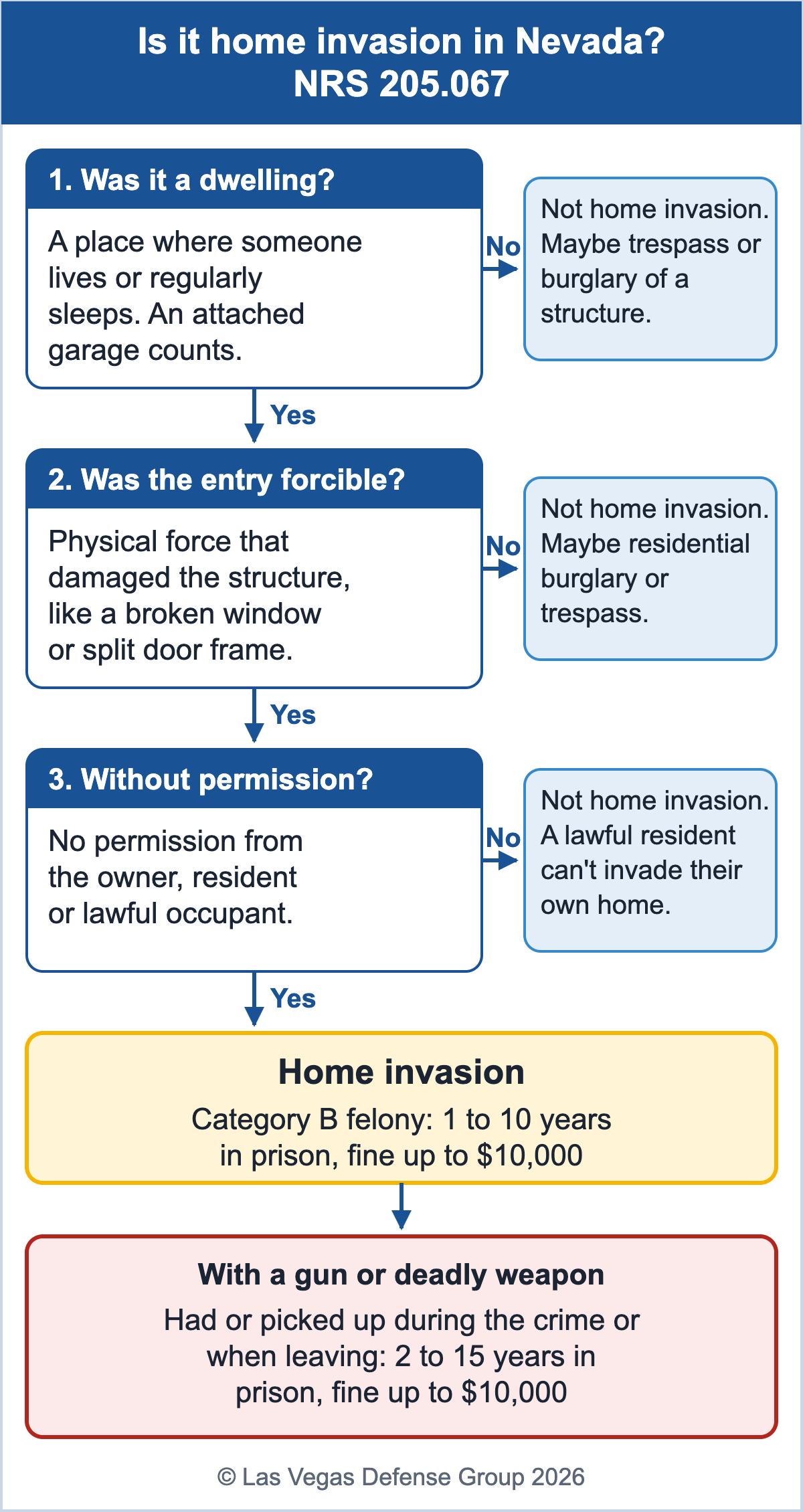
This flowchart sums up when an entry is home invasion:
2. What is the sentence for home invasion?
Home invasion is a category B felony. A conviction carries:13
- Prison: a minimum of at least 1 year and a maximum of up to 10 years in the Nevada State Prison, and
- Fine: up to $10,000, at the judge’s discretion.
With a gun or deadly weapon: 2 to 15 years
The sentence rises to 2 to 15 years in prison, plus a fine of up to $10,000, if you had a firearm or deadly weapon “or gain[ed] possession” of one at any time during the crime, before leaving or upon leaving the home.14 So someone who breaks in unarmed and takes a gun from inside faces the higher range. The State doesn’t have to recover the weapon or show it at trial.15
Example: Jason breaks a back window, climbs in with nothing in his hands and takes a handgun from a nightstand before leaving. Because he gained possession of a firearm before leaving, he faces 2 to 15 years instead of 1 to 10.
This rule is separate from Nevada’s general deadly weapon enhancement.
No probation with a prior burglary or home invasion
If you have a prior conviction for any burglary under NRS 205.060 or for home invasion, the judge cannot grant probation or suspend the sentence.16
Sexually motivated home invasion
If a court finds at a special hearing that the home invasion was sexually motivated, it counts as a “sexual offense” and the sentence includes lifetime supervision. You can later ask to be released from lifetime supervision, but only after at least 10 consecutive years without a conviction for an offense that threatens others, and only if you have followed the registration rules and a licensed professional finds you are not likely to be a threat.17
Plea bargains
Depending on the evidence, prosecutors are often willing to reduce a home invasion charge to trespass or another lesser offense through a plea bargain, especially when the proof of force or of a lack of permission is weak. Trespass is a misdemeanor carrying up to 6 months in jail, a fine of up to $1,000, or both.18
3. How do you fight a home invasion charge?
Because NRS 205.067 has narrow elements, the defense usually focuses on the one the State can prove least well. Common defenses include:
No damage, so no forcible entry
In our experience, the “damage” element is often where these cases turn. If the door was unlocked, a window was already open or the damage was there before, there was no forcible entry. Photos, repair records, a landlord’s move-in report or a neighbor’s account can show the damage was old or never happened.
Example: Ana walks in through an unlocked sliding door after an argument with the resident. Nothing is broken. Even if she wasn’t welcome, the entry wasn’t “forcible,” so it is not home invasion.
You had permission
If the owner, a resident or another lawful occupant let you in, there is no home invasion. Text messages, a key you were given, or a history of coming and going can prove permission. We often see these cases arise from disputes between roommates, partners or family members, where who was allowed in is unclear.
It was your own home
A lawful resident can’t commit home invasion of their own home. A lease, mail, ID or utility bills at that address can show you lived there.
It wasn’t a dwelling
A business, an office, a storage unit or a building that no one lives in or sleeps in is not a dwelling. Depending on the facts, the charge may be a lesser offense instead.
Mistaken identity
Many break-ins happen when no one is home, so the State often relies on doorbell video, fingerprints, phone records or a neighbor’s description. Grainy video and hurried identifications can point to the wrong person.
Overcharging
Prosecutors can charge every other crime committed during a home invasion separately, such as burglary, theft or battery.19 That often leads to a stack of charges from one entry. Challenging the weakest counts can give you leverage in negotiations.
4. Home invasion vs. burglary, housebreaking and trespass
These 4 Nevada crimes can come from the same kind of entry. The table below compares what the State must prove and the penalties.20
| Crime | What the State must prove | Penalty |
|---|---|---|
| Home invasion (NRS 205.067) | Forcible entry that damages a dwelling, without permission. No intent to commit another crime needed. | Category B felony: 1 to 10 years, fine up to $10,000 (2 to 15 years with a gun or deadly weapon) |
| Residential burglary (NRS 205.060) | Unlawfully entering or staying in a dwelling, intending to commit theft, assault or battery, any felony, or to get money or property by false pretenses. No force needed. | Category B felony: 1 to 10 years (2 to 15 years with a gun or deadly weapon) |
| Housebreaking (NRS 205.0813) | Forcibly entering a vacant or uninhabited dwelling, knowing there is no permission, to live there or let someone else live there. | First offense: gross misdemeanor, up to 364 days in jail, a fine up to $2,000, or both. Second or later: category D felony, 1 to 4 years, fine up to $5,000 |
| Trespass (NRS 207.200) | Going onto land or into a building to annoy the owner or commit an unlawful act, or staying after being warned. | Misdemeanor: up to 6 months in jail, a fine up to $1,000, or both |
The key differences: burglary turns on what you intended to do inside, while home invasion turns on force. Housebreaking applies to empty homes taken over to live in, and trespass needs no force and no dwelling. Home invasion is also different from robbery, which requires taking property from a person or in their presence by force or fear.
For more, see our article on the difference between home invasion and burglary in Nevada.
5. Home invasion cases in Las Vegas
In Clark County, a home invasion case usually starts in the Las Vegas Justice Court (or the justice court in Henderson or North Las Vegas, depending on where the entry happened). A justice of the peace holds a preliminary hearing to decide whether there is enough evidence for the case to go forward. If there is, the case moves to the Eighth Judicial District Court for arraignment, motions, negotiations and any trial. Prosecutors can also skip the preliminary hearing by taking the case to a grand jury.
6. Frequently asked questions
Is home invasion a felony in Nevada?
Yes. Home invasion is a category B felony punished by 1 to 10 years in prison and a fine of up to $10,000.
What is the sentence for home invasion with a weapon?
If you had or picked up a firearm or deadly weapon during the home invasion or when leaving, the sentence is 2 to 15 years in prison and a fine of up to $10,000.
What is the difference between home invasion and burglary in Nevada?
Home invasion requires a forcible entry that damages a dwelling but no plan to commit another crime. Residential burglary requires intent to commit a crime such as theft inside, but no force.
Is it home invasion if no one was home?
Yes. NRS 205.067 applies whether or not anyone is present at the time of the entry.
Can you get probation for home invasion in Nevada?
Probation may be possible on a first offense, but not if you have a prior conviction for burglary or home invasion.
Talk to a Las Vegas home invasion lawyer
If you’ve been arrested or charged with home invasion, our Las Vegas criminal defense attorneys can review the evidence of force, permission and identity with you. Call 702-DEFENSE (702-333-3673) or contact us for a free consultation.
Additional reading
- Unlawful reentry (NRS 205.082)
- Housebreaking (NRS 205.0813)
- Unlawful occupancy/squatting (NRS 205.0817)
- What’s the difference between home invasion and burglary in Nevada?
- Is housebreaking different from squatting under Nevada law?
- Vandalism (NRS 206.310)
Legal references:
- NRS 205.067(1): “A person who, by day or night, forcibly enters a dwelling without permission of the owner, resident or lawful occupant, whether or not a person is present at the time of the entry, is guilty of invasion of the home.”
- Nevada Pattern Criminal Jury Instructions 13.09 (Nev. Sup. Ct. 2023): “The crime of INVASION OF THE HOME consists of the following elements: (1) The Defendant willfully, by day or night; (2) Forcibly enters; (3) An inhabited dwelling, whether or not a person is present at the time of the entry; (4) Without permission of the owner, resident, or lawful occupant.”
- Nevada Pattern Criminal Jury Instructions 13.09 (Nev. Sup. Ct. 2023): “Entry” of an occupied dwelling “includes the entrance of the intruder, or the insertion of any part of his or her body or of any instrument or weapon held in his or her hand ….”
- NRS 205.067(5)(b): “‘Forcibly enters’ means the entry of an inhabited dwelling involving any act of physical force resulting in damage to the structure.”
- NRS 205.060(6)(b) (applied to home invasion by NRS 205.067(5)(a)): “‘Dwelling’ means any structure, building, house, room, apartment, tenement, tent, conveyance, vessel, boat, vehicle, house trailer, travel trailer, motor home or railroad car, including, without limitation, any part thereof that is divided into a separately occupied unit: (1) In which any person lives; or (2) Which is customarily used by a person for overnight accommodations, regardless of whether the person is inside at the time of the offense.”
- Austin v. State, 142 Nev. Adv. Op. 12, 587 P.3d 826, 832 (Nev. Ct. App. 2026): “[A]n attached garage constitutes part of a dwelling for purposes of the home invasion statute ….”
- Dunham v. State, 134 Nev. 563, 426 P.3d 11, 12-15 (2018): “inhabiting a dwelling does not require permanent or continuous use, and an individual is not limited to inhabiting one dwelling at a time.”
- Austin v. State, 587 P.3d 826 (Nev. Ct. App. 2026) (noting that 2019 Nev. Stat., ch. 633, § 56, amended NRS 205.067(1) “to apply to a forceable entry into ‘a dwelling’ rather than a forceable entry into ‘an inhabited dwelling'”).
- Truesdell v. State, 129 Nev. 194, 202, 304 P.3d 396, 401 (2013): “[A] person cannot commit the crime of home invasion by forcibly entering his or her own home if that person is a lawful occupant or resident of the home.”
- Nevada Pattern Criminal Jury Instructions 13.09 (Nev. Sup. Ct. 2023): “The offense of home invasion does not require proof of entry with a specific intent to commit a crime.”
- Austin v. State, 587 P.3d at 831 (evidence that the defendant banged on the laundry-room door until it bowed and the lock was damaged supported attempted home invasion).
- NRS 193.153(1)(a)(3) (attempt to commit a category B felony with a maximum of 10 years or less is a category C felony); NRS 193.130(2)(c) (category C felony: 1 to 5 years; fine up to $10,000).
- NRS 205.067(2): “A person convicted of invasion of the home is guilty of a category B felony and shall be punished by imprisonment in the state prison for a minimum term of not less than 1 year and a maximum term of not more than 10 years, and may be further punished by a fine of not more than $10,000.”
- NRS 205.067(4): “A person convicted of invasion of the home who has in his or her possession or gains possession of any firearm or deadly weapon at any time during the commission of the crime, at any time before leaving the structure or upon leaving the structure, is guilty of a category B felony and shall be punished by imprisonment in the state prison for a minimum term of not less than 2 years and a maximum term of not more than 15 years, and may be further punished by a fine of not more than $10,000.”
- Nevada Pattern Criminal Jury Instructions (Nev. Sup. Ct. 2023), Invasion of the Home with Possession of a Deadly Weapon (p. 254): “the State is not required to prove that the specific firearm or deadly weapon at issue was recovered, nor is the State required to produce the subject weapon at trial.”
- NRS 205.067(2): “A person who is convicted of invasion of the home and who has previously been convicted of any burglary pursuant to NRS 205.060 or invasion of the home must not be released on probation or granted a suspension of sentence.”
- NRS 176.0931(3), (5)(c)(3) (“sexual offense” includes “invasion of the home if the act is determined to be sexually motivated at a hearing conducted pursuant to NRS 175.547”; release requires, among other things, no qualifying conviction “for an interval of at least 10 consecutive years”).
- NRS 207.200(1); NRS 193.150(1): a misdemeanor is punished “by imprisonment in the county jail for not more than 6 months, or by a fine of not more than $1,000, or by both fine and imprisonment.”
- NRS 205.070: “Every person who, in the commission of a burglary or invasion of the home, commits any other crime, may be prosecuted for each crime separately.”
- NRS 205.060(1)(a), (2)(d), (5) (residential burglary); NRS 205.0813 (housebreaking); NRS 193.130(2)(d) (category D felony); NRS 207.200 and 193.150 (trespass).