







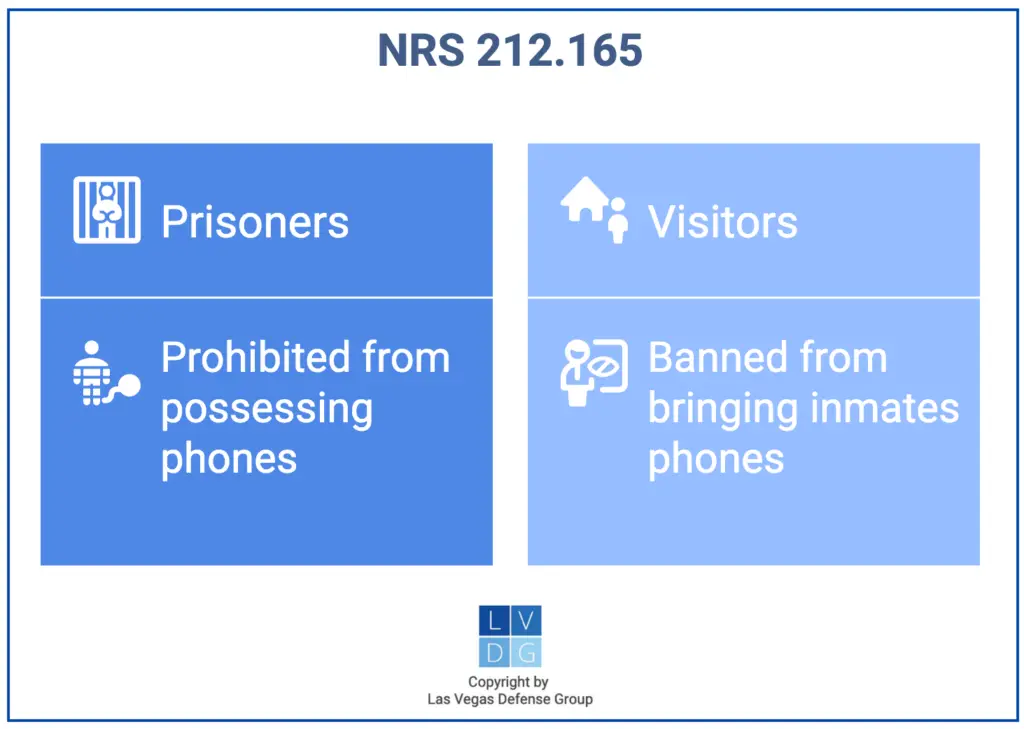
NRS § 212.165 is the Nevada law that prohibits knowingly furnishing a portable telecommunications device to a state prisoner without lawful authorization. It also prohibits unauthorized carrying of these devices into state correctional facilities and unauthorized possession by state prison and local jail inmates.
The penalties depend on who has the device and where the conduct occurs:
- Furnishing a device to a state prisoner: Category E felony, generally carrying probation with a suspended one-to-four-year prison term.
- Carrying a device into a state correctional facility: Misdemeanor, carrying up to six months in jail and/or $1,000 in fines.
- Possession by a state prisoner: Category D felony, carrying one to four years in prison and up to $5,000.
- Possession by a local jail inmate: Category D felony if the inmate is held on a felony, carrying one to four years in prison and up to $5,000; a gross misdemeanor if held on a gross misdemeanor, carrying up to 364 days in jail and/or $2,000; or a misdemeanor if held on a misdemeanor, carrying up to six months and/or $1,000.1
When we defend these cases, we look beyond where officers found the phone. We examine who handled it, whether its presence was authorized, and whether the evidence actually connects our client to the charged conduct. Those details can support a dismissal, a reduced charge, or a defense at trial.
In this article, our Las Vegas criminal defense attorney discuss the following key topics regarding NRS 212.165.
- 1. Furnishing a Device to a State Prisoner
- 2. Devices Covered by the Law
- 3. Carrying a Device into a State Facility
- 4. Defenses to the Charges
- 5. Penalties
- 6. Sentence Modification for Local Jail Inmates
- 7. Record Sealing
- Frequently Asked Questions
1. Furnishing a Device to a State Prisoner
To convict you under NRS 212.165(1), Nevada prosecutors must prove beyond a reasonable doubt these three elements:
- You knowingly furnished, attempted to furnish, or helped furnish or attempt to furnish a portable telecommunications device; and
- The intended recipient was a prisoner in a Nevada Department of Corrections (NDOC) institution or facility, or another place covered by the statute; and
- You acted without lawful authorization.
The prisoner does not need to receive or use the device for an attempted furnishing charge. Helping someone else deliver it can also violate the law.2
Example: Steve mails his incarcerated daughter a cell phone without lawful authorization so they can communicate privately. If prison staff intercept it, Steve may still face a charge for attempting to furnish the phone. Wanting to stay in touch with his daughter does not excuse knowingly sending an unauthorized device.
In defending a mailed-package case, we would investigate who packed and sent it, who knew about the device, and whether messages or surveillance undercut the accusation. A sender’s name on a package does not, by itself, establish their guilt.
2. Devices Covered by the Law
NRS 212.165 covers portable telecommunications devices that can enable communication with someone outside the institution or facility. The statutory definition includes telephones, cell phones, personal digital assistants, transmitting radios, and qualifying computers or tablets. It also includes an apparatus associated with a device that can enable outside communication.
A computer or tablet does not have to be connected to a network when officers find it. The definition also covers devices capable of connecting wirelessly or otherwise communicating with a person or device outside the facility.3
We examine the actual device and any approval records. The jail staff could be mistaken when they called the device “contraband.”
3. Carrying a Device into a State Facility
NRS 212.165(2) makes it a misdemeanor to carry a portable telecommunications device into an NDOC institution, facility, or other covered location without lawful authorization. No transfer to a prisoner is required.
Unlike the furnishing provision, this subsection does not expressly use the word “knowingly.” Therefore, forgetting a phone in your pocket does not excuse bringing it inside.4
We would review entry procedures, staff instructions, any permission given, and the exact location where the device was found. These facts help us evaluate the strength of our client’s case and whether dismissal or a reduction is appropriate.
4. Defenses to the Charges
Here at Las Vegas Defense Group, we have represented countless people charged with jail- or prison-related crimes, such as providing inmates with a phone or phone possession by an inmate. In our experience, the following five defenses have proven very effective with prosecutors, judges, and juries in getting NRS 212.165 charges reduced or dismissed.
- No knowing furnishing: Perhaps someone secretly took your phone or placed it in a package without your knowledge.
- Lawful authorization: You had valid permission for having or furnishing the phone.
- No possession or control: The device was in a shared area and was not in the accused inmate’s possession, custody, or control.
- Missing or unreliable evidence: The records, witnesses, or video do not reliably connect the defendant to the alleged conduct.
- The wrong statutory provision: The prosecution failed to establish the location, prisoner status, or other facts required under the law.5
We look for gaps between the officers’ conclusions and the evidence supporting them. We can use those gaps to seek dismissal or negotiate a reduction.
5. Penalties
Furnishing a Device
Unauthorized knowing furnishing of a phone to an inmate (or attempted furnishing or assistance) under NRS 212.165(1) is a category E felony. It carries a one-to-four-year Nevada State Prison sentence, generally suspended while you serve probation, and a possible fine of up to $5,000.
If you have two or more qualifying prior felony convictions, the judge may deny probation and impose prison. Even when probation is granted, its conditions can include up to one year in county jail.6
Carrying a Device into a State Facility
Unauthorized carrying of a phone into a Nevada prison or other covered facility under NRS 212.165(2) is a misdemeanor carrying:
- Up to six months in jail; and/or
- Up to $1,000 in fines.7
Possession by an Inmate
Unauthorized possession, custody, or control of a phone by a state prisoner under NRS 212.165(3) is a category D felony, carrying one to four years in prison and a possible fine of up to $5,000.
For local jail inmates under NRS 212.165(4), the classification depends on the charge, conviction, or sentence for which they are in custody:
- Felony: Category D felony, carrying one to four years in prison and a possible fine of up to $5,000.
- Gross misdemeanor: Gross misdemeanor, carrying up to 364 days in jail and/or $2,000 in fines.
- Misdemeanor: Misdemeanor, carrying up to six months in jail and/or $1,000 in fines.
Sentences for these inmate-possession offenses cannot be suspended or receive probation. They must run consecutively, meaning they run after any sentences for the offenses underlying the inmate’s custody.8
6. Sentence Modification for Local Jail Inmates
An inmate convicted and sentenced for phone possession in a local jail under NRS 212.165(4) may be able to petition the original court for a sentence modification if the underlying charge is later reduced, declined for prosecution, or dismissed.
Under NRS 212.165(6), if the inmate gets their underlying charge reduced, they can ask for a possession sentence equivalent to the penalty for the new, lesser underlying conviction. Under NRS 212.165(7), if the inmate gets their case dismissed, or prosecutors decide not to press the underlying charge, they can request to reduce the phone-possession sentence to a misdemeanor.
To grant such a sentencing modification in Nevada, the court requires good cause; it is not automatic.9
We would compare the original custody records with the final outcome of the underlying case and determine whether a petition could reduce our client’s sentence.
7. Record Sealing
The waiting period for sealing a Nevada criminal record depends on the conviction:
- Category E felony: Generally two years after release from actual custody or discharge from parole or probation, whichever occurs later.
- Category D felony: Generally five years after release from actual custody or discharge from parole or probation, whichever occurs later.
- Gross misdemeanor: Generally two years after release from actual custody or discharge from probation, whichever occurs later.
- Misdemeanor under this statute: Generally one year after release from actual custody or the end of the suspended sentence, whichever occurs later.
If the charge is dismissed or you are acquitted, you can generally seek sealing right away.10 Note that the record seal process itself is not automatic and may take a year or more.

Frequently Asked Questions
Can I be charged if the prisoner never receives the phone?
Yes. NRS 212.165(1) expressly prohibits attempting to furnish a portable telecommunications device to a state prisoner without lawful authorization. Helping someone else attempt the delivery is also covered.
We would examine whether the evidence shows your knowing involvement. An intercepted package does not automatically prove who put the phone inside or who knew it was there.
Will I go to prison for giving a phone to a state prisoner?
Not necessarily. The furnishing offense is a category E felony that generally requires probation and a suspended one-to-four-year prison sentence. A judge may deny probation if you have two or more qualifying prior felony convictions. Probation can include up to one year in county jail, and a fine of up to $5,000 is possible.
We first look for grounds to defeat or reduce the charge. If a conviction cannot be avoided, we can present evidence supporting probation without jail where the law allows it.
Is an approved prison tablet illegal?
No, not merely because it is a tablet. The statute prohibits the covered conduct without lawful authorization. A tablet approved for an inmate’s use is different from a privately supplied, unauthorized device.
We would review the approval records and the scope of the permission. Those records may help defeat an allegation that the device was unauthorized.
Does finding a phone in a shared cell prove that it was mine?
Not by itself. The inmate-possession provisions require possession, custody, or control. Ownership is not required, but the prosecution must prove the accused inmate’s connection to the device beyond a reasonable doubt.
We would examine who had access to the area, where the phone was hidden, and whether messages, witnesses, or other evidence actually connect you to it.
Can a local jail phone-possession sentence be reduced if the original charge is dismissed?
Possibly. NRS 212.165(7) allows a person convicted and sentenced under the local jail possession provision to petition the original court to reduce that sentence to a misdemeanor if the underlying charge is dismissed or declined for prosecution. The court must find good cause, and relief is not guaranteed.
The court will not automatically change the phone-possession sentence when the other case ends. We would obtain the underlying case’s disposition and explain why it supports a lower sentence.
Legal References
- NRS 212.165(1)-(5); NRS 193.130; NRS 193.140; NRS 193.150; NRS 176A.100(1)(b).
- NRS 212.165(1).
- NRS 209.417(6)(a), (e); NRS 212.165(9)(d).
- NRS 212.165(1)-(2).
- NRS 212.165(1)-(4).
- NRS 212.165(1); NRS 193.130(2)(e); NRS 176A.100(1)(b).
- NRS 212.165(2); NRS 193.150.
- NRS 212.165(3)-(5); NRS 193.130(2)(d); NRS 193.140; NRS 193.150.
- NRS 212.165(6)-(8).
- NRS 179.245; NRS 179.255.