







House arrest in Nevada allows eligible people to remain at home under supervision while awaiting trial or serving a sentence. Often called residential confinement or home detention, it usually involves an ankle monitor and limits on where you can go. In Clark County, LVMPD operates an Electronic Monitoring Program (EMP).
Key Things to Know:
- Approval: Eligibility depends on your case, the program, and the court’s order. A nonviolent charge or clean record can help, but there is no single eligibility rule for every Nevada program.
- Monitoring: Local EMP participants wear a GPS ankle device and follow their assigned restrictions. House arrest and electronic monitoring are related, but not every monitoring arrangement requires you to stay home all day.
- Leaving home: Your conditions may allow approved work, school, treatment, medical care, and other activities. Do not assume an important errand is automatically permitted.
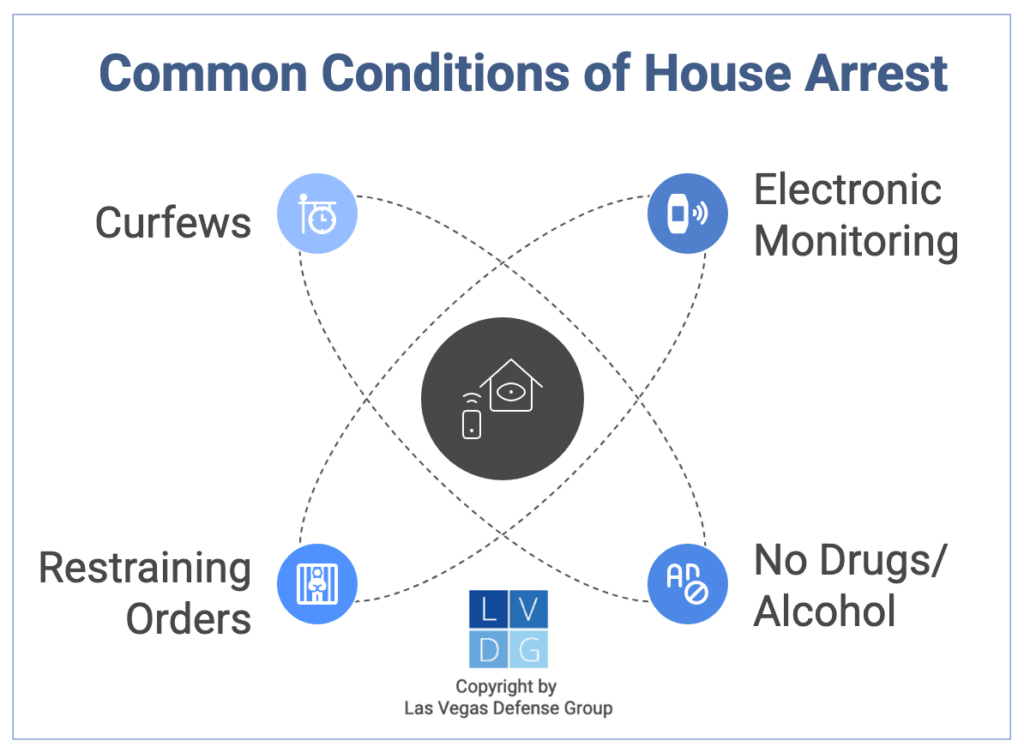
- Other rules: You may face drug and alcohol testing, home visits, searches, travel limits, and restrictions on contacting certain people.
- Length: The court order and applicable law control. There is no universal rule that every day of house arrest replaces one day in jail.
- Violations: Breaking the rules can lead to arrest, loss of release privileges, and sometimes a separate criminal charge.
Costs vary by program. Las Vegas Municipal Court publishes a $12 daily monitoring fee and a $100 enrollment fee. These are not statewide rates or necessarily the rates for the separate Clark County program.1
Our goal is to keep you out of custody whenever the law allows. We build the request around your real life: your job, housing, treatment, and the people who depend on you. We also push back against unnecessary restrictions so that a release order gives you a workable chance to keep your life together.
In this article, our Nevada criminal defense attorneys explain what you need to know about Las Vegas house arrest laws:
- 1. Governing Laws
- 2. Timing and Duration
- 3. How It Works
- 4. Eligibility
- 5. Violations
- 6. Costs
- 7. Cell Phones
- 8. Alcohol and Drug Testing
- 9. Visitors
- 10. Different Counties
- 11. Residential Confinement Programs
- Government Resources
- Frequently Asked Questions
- Additional Reading
1. Governing Laws
Nevada has several house arrest laws. The law that applies depends on whether you are awaiting trial, serving a local jail sentence, on probation, or transferring from state prison.
| Stage of Case | Main Legal Authority for House Arrest |
|---|---|
| Pretrial release | NRS 178.4851 governs release conditions. NRS 211.300 also authorizes electronic supervision of an unconvicted person with court approval. |
| Electronic supervision instead of local jail | NRS 211.250 through 211.290 address eligibility, rules, fees, and administration. |
| Probation | NRS 176A.100 and 176A.400 address probation and its conditions. NRS 176A.440 governs enhanced supervision, including an initial period of electronic supervision. |
| Transfer from state prison | NRS 209.392, 209.3923, 209.3925, and 209.429 authorize different forms of residential confinement or other supervision for eligible inmates. |
For pretrial release, the court generally must choose the least restrictive conditions necessary to protect the community or ensure your court appearances. It must explain its decision on the record. House arrest can accompany bail or release without money bail; it should not be imposed automatically just because you face a serious charge.2
Our approach is to ask what restriction is actually necessary in your case. If a narrower travel limit or another condition can address the court’s concern, we can argue for that instead of full home confinement.
2. Timing and Duration
House arrest can begin before trial, at sentencing, or later through an authorized supervision or prison-transfer program. It is not limited to two points in a Nevada case:
- Before trial: Monitoring may continue while the case is pending, subject to court review and changes in your release conditions.
- After conviction: The sentence, probation conditions, and applicable law determine the term.
- During imprisonment: An eligible inmate may transfer to residential confinement under a separate statutory program.
Do not assume house arrest always replaces jail day for day. For example, when the enhanced penalties in NRS 483.560(2) apply to driving during specified DUI-related license suspensions, revocations, or restrictions, the statute provides for 30 days to six months in jail OR 60 days to six months of residential confinement, plus a $500 to $1,000 fine. That is a difference in minimum sentences, not a universal two-for-one conversion rule.3
Release also depends on completing the required intake and monitoring arrangements. Do not promise your employer or family a same-day release before those arrangements are confirmed.
We work to get the start date, end date, and daily schedule made clear. A vague understanding of when you can leave or when monitoring ends can put your freedom at risk.

3. How It Works
In Nevada, your court order and program instructions control where you can go on house arrest. LVMPD currently lists medium-level and high-level supervision. The exact restrictions depend on the order and your assigned conditions; those labels do not create identical rules for every participant.4
Follow your written schedule, reporting requirements, and equipment instructions. Ask about work shifts, travel time, appointments, and any proposed change before acting. Permission to work does not automatically include shopping on the way home.
Clark County permits verified employment and approved medical appointments. A medical emergency requiring immediate care is an exception to advance approval. Its program also permits verified court-required classes, requires an ankle GPS device, allows home searches for contraband, and requires a landline or cell phone.5
Other conditions may restrict alcohol, drugs, weapons, travel, or contact with an alleged victim. GPS monitoring can help enforce prohibited areas, such as a protected person’s home.
We encourage clients to keep their instructions and approvals together. If a work shift changes or the monitor malfunctions, report it promptly and keep the messages. That record can help us challenge a claim that you deliberately broke the rules.

4. Eligibility
Eligibility for house arrest in Nevada depends on the program and your individual circumstances. Under NRS 211.250, local electronic supervision generally requires suitable housing and a finding that supervision poses no unreasonable risk to public safety, unless the sentencing court orders otherwise.
A job can strengthen your request, but NRS 211.260 expressly says employment is not required for eligibility under that local electronic-supervision framework. State prison-transfer programs have different requirements.6
A useful request can include:
- A proposed address and information about who lives there;
- Your work schedule, job offer, or education plan;
- Treatment appointments and medical needs;
- Childcare or other family responsibilities; and
- Evidence of court attendance and compliance with previous orders.
A clean record and low risk of reoffending can help, but neither first-offender status nor a nonviolent charge guarantees approval. Likewise, a prior conviction does not automatically disqualify you from every program.
We build a concrete plan the judge can evaluate. Showing how you will keep your job, get to treatment, and follow the schedule gives us more to work with than simply asking for leniency.
5. Violations
Violating house arrest in Nevada can result in arrest, stricter conditions, or a return to jail or prison. The procedure depends on whether you are on pretrial release, probation, local electronic supervision, or a state residential-confinement assignment.
What happens after a pretrial violation arrest?
Under Johnston v. Eighth Judicial District Court, you have a right to a prompt hearing after being arrested for an alleged pretrial release violation. The State must show probable cause that you violated a condition, and you may contest its evidence. This is not the beyond a reasonable doubt standard used to convict you at trial.7
Can I face a new criminal charge?
NRS 212.220 makes certain unauthorized absences and removing or disabling a monitoring device separate crimes. (This includes attempts to remove or disable the device.) Subject to the statute’s exception for NRS 213.400, the new offense is generally:
- A gross misdemeanor if the electronic supervision relates to a felony or gross misdemeanor; or
- A misdemeanor if the supervision relates to a misdemeanor.
A sentence under NRS 212.220 runs consecutively to the sentence for the original offense. The court must also order restitution for device damage or loss. Note that a lost device or equipment alert does not, by itself, prove you committed a crime.8
If you are accused of a violation, contact your attorney promptly. We can examine location records, approvals, messages, and evidence of equipment problems to fight an unsupported allegation. If a violation occurred, we can argue for continued release or a lawful alternative to incarceration. An accident does not automatically excuse a violation, so documenting what happened matters.
6. Costs
House arrest fees in Nevada depend on the supervising program. Las Vegas Municipal Court publishes a $100 enrollment fee plus $12 per day. Thirty days would therefore total $460 for those two listed charges.
For local electronic supervision governed by NRS 211.280, payment toward the fees must be based on your ability to pay. Ask about the applicable assessment if you cannot afford the published amount.9
Clark County’s separate EMP accepts money orders and provides a credit-card payment link through GTL and detention-center lobby kiosks. Its published facility number is 289101. Follow the payment instructions for your own program.10
We tell clients to raise money problems before missed payments become an issue. Bring income records and essential expenses so we can support a request for an affordable arrangement.

7. Cell Phones
Clark County EMP requires a landline or cell phone, and Las Vegas Municipal Court requires a working phone. Other programs may have different equipment and communication requirements. A phone requirement does not give you permission to contact someone protected by a no-contact order.11
Keep your contact information current and follow instructions about answering calls. Ask the supervising agency what to do if your phone stops working or your service is interrupted.
We recommend saving the monitoring office’s number and reporting communication problems as soon as possible. A record of your efforts to stay in touch can help us explain a missed call or other disputed incident.
8. Alcohol and Drug Testing
You must follow the alcohol, drug, and testing conditions imposed in your Nevada case. These can include abstinence, random testing, treatment, or an alcohol-monitoring device. Do not assume that something legal for other adults is permitted under your supervision conditions.
A SCRAM CAM bracelet tests perspiration for alcohol approximately every 30 minutes. Some supervision arrangements instead use, or also require, remote breath tests.12
GPS monitoring and alcohol monitoring serve different purposes. Wearing a location monitor does not necessarily mean it also tests for alcohol.
We encourage clients to disclose prescriptions through the program’s required process and get testing instructions clarified in writing. Do not stop prescribed treatment on your own. If a result is disputed, tell your attorney promptly so the records and possible explanations can be reviewed.

9. Visitors
Your supervision conditions in your Nevada case determine whether visitors are allowed. Being permitted to live at home does not override no-contact orders, restrictions on particular people, or rules about contraband.
For example, an alleged victim’s invitation does not cancel a court order prohibiting contact. If someone you cannot contact lives at your proposed address, that issue needs to be resolved before you move there.
We tell clients to discuss household arrangements early. Identifying a suitable address and explaining the rules to the people living there can prevent a housing problem from undermining the request for release.
10. Different Counties
The supervising agency in a Nevada case depends on your court and legal status, not just your county. A municipal program, county program, and state probation program can operate in the same area with different procedures.
- Clark County: LVMPD operates EMP, while Las Vegas Municipal Court has its own house arrest unit. The municipal program publishes qualifications for misdemeanor cases, including a judicial referral, permanent residence, and working phone.
- Washoe County: The former Department of Alternative Sentencing now operates as an Alternative Sentencing Unit within the Sheriff’s Office. The Second Judicial District Court also operates Pretrial Services. Its pretrial and specialty-court drug and alcohol testing transitioned to Averhealth on November 3, 2025.
- Other Nevada counties: Identify the agency named in your order. Local authorities and Nevada Parole and Probation have different responsibilities depending on the case.
Check the instructions for your assigned program rather than applying another county’s rules.13
We make a point of identifying who can approve schedule changes. Getting permission from the wrong office may not protect you if your assigned supervisor reports a violation.
11. Residential Confinement Programs
Eligible state prison inmates may qualify for residential confinement through NDOC and Nevada Parole and Probation. These assignments are distinct from an ordinary request for pretrial house arrest.
- 317 Program: A residential confinement option for qualifying inmates under NRS 209.392. Eligibility includes statutory exclusions and agency screening. Some category B felony inmates can qualify with the required public safety finding.
- 305 Program: A treatment-related route for eligible inmates covered by NRS 209.425 through 209.429, including qualifying felony DUI cases. It is not an automatic substitute for every DUI sentence.
- 184 Program: A reentry-court route for eligible inmates with drug or alcohol problems, involving court oversight and Parole and Probation supervision.
- 298 Program: Medical residential confinement or other appropriate supervision under NRS 209.3925 for qualifying inmates with serious physical incapacity or ill health, including qualifying terminal illness.
Each route has its own requirements. Do not apply one blanket rule about criminal history, employment, or medical eligibility to all four. Assignments under NRS 209.392 and 209.429 remain a continuation of imprisonment rather than parole.14
For a family seeking an inmate’s transfer, we start with the actual conviction, sentence, institutional record, and proposed living arrangements. That helps identify a legally available route and the records needed to support it.
Government Resources
- LVMPD House Arrest – Local EMP information.
- Clark County House Arrest – Program rules and payment information.
- Las Vegas Municipal Court Resources – Municipal program qualifications and fees.
- Washoe County Pretrial Services – District court pretrial services.
- Nevada Parole and Probation: Residential Confinement – State program information.
- U.S. Probation, District of Nevada: Location Monitoring – Information for federal cases, which follow a separate legal framework.

Frequently Asked Questions
What is the house arrest law in Nevada?
Nevada uses different laws for different situations. NRS 178.4851 governs pretrial release conditions, NRS 211.250 through 211.300 address local electronic supervision, and Chapters 176A and 209 cover probation and state residential-confinement programs.
We first identify which law applies to your case. That determines who can approve house arrest and what arguments can help you qualify.
How much does house arrest cost in Las Vegas?
Las Vegas Municipal Court lists a $100 enrollment fee and $12 per day. Other programs can charge different amounts. NRS 211.280 requires participants in the covered local programs to pay toward fees according to their ability to pay.
If you cannot afford monitoring, tell your attorney early. We can use your financial records to support a request that accounts for your circumstances.
Can I work or take care of my family while on house arrest?
Your conditions may permit work and approved family-related activities. However, house arrest does not automatically authorize school pickups, grocery trips, or other errands outside the home.
We help clients identify necessary trips before requesting a schedule. A clear plan can help you keep earning income and caring for your family without risking an unauthorized absence.
Do I need a job to qualify?
Not for every program. NRS 211.260 says employment is not required for eligibility under the local electronic supervision framework. State inmate programs have separate requirements.
If you are unemployed, retired, disabled, or caring for family, we can explain those circumstances and present another workable supervision plan.
What happens if I violate house arrest?
You may be arrested, face stricter conditions, or return to custody. Certain unauthorized absences or device tampering can also lead to a new criminal charge. After an arrest for an alleged pretrial release violation, you have a right to a prompt hearing where the State must establish probable cause.
Contact your attorney promptly and preserve messages, appointment records, and evidence of equipment trouble. We can challenge an unsupported allegation or seek an alternative to incarceration.
Can I leave home for a medical emergency?
Clark County’s published rules make an exception to advance approval for medical emergencies requiring immediate care. Ordinary appointments still require verification and prior approval.
Get emergency care when needed, notify the program as soon as you safely can, and keep the medical records. Those documents can help explain why you left.
Do I need a phone?
Clark County EMP requires a landline or cell phone, and Las Vegas Municipal Court requires a working phone. Follow your own program’s communication instructions.
We recommend reporting a broken phone or service interruption immediately through an available channel and keeping a record of the report.
Does house arrest restore my right to drive?
No. Permission to leave for work or another activity does not restore a suspended or revoked driver’s license. You must separately satisfy the DMV‘s requirements and any applicable ignition-interlock restrictions.
We tell clients to arrange lawful transportation before submitting a travel schedule. An approved destination will not protect you from a new charge for driving without valid privileges.
Additional Reading
These articles discuss house arrest generally; they do not replace Nevada’s current laws or your individual court order.
- Home as Prison: The Use of House Arrest – Federal Probation.
- Between the ‘Home’ and ‘Institutional’ Worlds: Tensions and Contradictions in the Practice of House Arrest – Critical Criminology.
- House Arrest: A Critical Analysis of an Intermediate-Level Penal Sanction – University of Pennsylvania Law Review.
- A Brief History of House Arrest and Electronic Monitoring – Northern Kentucky Law Review.
- Exploring the Option of House Arrest – Federal Probation.
Legal References
- NRS 178.4851; NRS 211.250–211.300; Las Vegas Municipal Court Resources, House Arrest.
- NRS 178.4851; NRS 211.300; NRS 176A.100, 176A.400, 176A.440; NRS 209.392, 209.3923, 209.3925, 209.429; Johnston v. Eighth Judicial Dist. Court (Nev. 2022) 518 P.3d 94 (requiring individualized findings supporting pretrial release conditions).
- NRS 483.560(2); NRS 176A.450; NRS 209.392.
- LVMPD, House Arrest (listing medium-level and high-level supervision).
- Clark County, House Arrest; NRS 211.270.
- NRS 211.250; NRS 211.260; NRS 178.4853.
- Johnston v. Eighth Judicial Dist. Court (Nev. 2022) 518 P.3d 94 (prompt hearing and probable-cause standard for alleged pretrial release violations); NRS 178.4851; NRS 176A.630; NRS 211.270.
- NRS 212.220; NRS 213.400.
- Las Vegas Municipal Court Resources, House Arrest; NRS 211.280.
- Clark County, House Arrest: Payment information.
- Clark County, House Arrest; Las Vegas Municipal Court Resources, House Arrest; NRS 178.4851.
- SCRAM Systems, SCRAM CAM; NRS 176A.400.
- LVMPD, House Arrest; Las Vegas Municipal Court Resources; Washoe County Sheriff’s Office, Alternative Sentencing Unit; Washoe County, Sober 24 (Averhealth).
- Nevada Parole and Probation, Residential Confinement; NRS 209.392; NRS 209.3925; NRS 209.425–209.429.