

Most Nevada DUI defendants prefer to take a plea bargain rather than risk a guilty verdict at a time-consuming and expensive trial.
However, going to trial for a DUI can be in your best interest, especially if you have a strong case. As long as the prosecutor cannot prove beyond a reasonable doubt that you were driving under the influence of alcohol or drugs, the trial verdict should be “not guilty.”
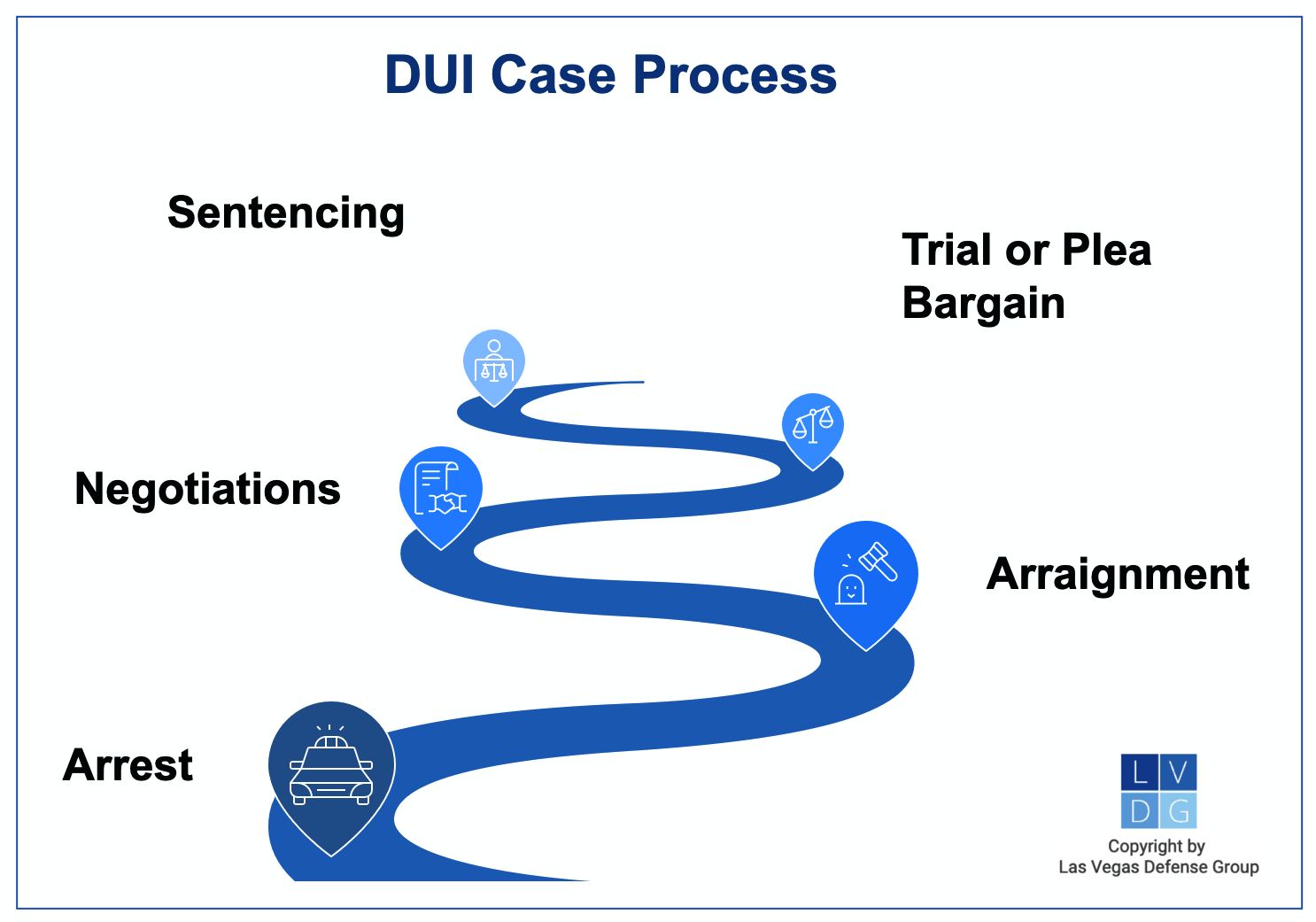
The length and complexity of DUI trials depend on the severity of the charges and the amount of available evidence. In this article, our Las Vegas DUI lawyers explain the process of taking a Nevada DUI case to trial.
- 1. Arrest
- 2. Arraignment
- 3. Negotiations
- 4. Pretrial Phase
- 5. Trial
- 6. Sentencing
- 7. Post-Conviction Relief
- 8. Record Sealing
- 9. DMV Hearing
- 10. Do I need an attorney?
- Frequently Asked Questions
- Additional Reading
1. Arrest
Most Nevada DUI cases start with a police officer pulling you over for a traffic violation or arriving at an accident scene.
The officer may then ask you to take a preliminary breath test and to perform field sobriety tests. Depending on the results, the officer may arrest you for DUI and book you at a local jail.
Following the arrest, you then elect to take a breath test or a blood test. (If you are suspected of DUI with drugs, you must take a blood test.) Afterwards, you are usually released from jail on O.R. or bail.1

2. Arraignment
After your DUI arrest in Nevada, prosecutors examine the police report and chemical test results. Note that blood test results take several weeks to come back.
Prosecutors then decide whether there is enough evidence to press DUI charges. If so, prosecutors charge you during a court hearing called an arraignment.
Arraignments typically occur a few weeks after the arrest. Though if you never bailed out, the arraignment would occur within 72 hours.
You usually do not have to go to your arraignment as long as you retained an attorney to appear for you. Your attorney will then enter an initial plea of “not guilty” for you.
Finally, the judge will schedule the next court date (usually a few weeks later).2

3. Negotiations
After your DUI arraignment in Nevada, your defense attorney and prosecutor will try to negotiate a resolution to avoid trial.
Your attorney’s first strategy is to try to get the entire case dismissed by showing that there is insufficient evidence to sustain a DUI conviction. Note that prosecutors rarely agree to dismiss DUI charges unless there is a glaring problem with their evidence.
Your attorney’s next strategy is to try to get the DUI charge reduced to reckless driving or careless driving. Note that prosecutors cannot lawfully reduce DUI charges unless their case has evidentiary problems.
If the prosecutor refuses to dismiss or reduce your DUI charges, your attorney has a final strategy to avoid a trial: To accept the DUI charge on the condition that the prosecution agrees to minimum penalties.
Most DUI cases resolve with a plea. However, you should never feel pressured to take a plea, especially if you were falsely accused or the police committed misconduct.3

4. Pretrial Phase
The DUI pretrial phase, which occurs alongside negotiations, is when the prosecution and your defense prepare for trial. (This is also typically the time you can have a DMV hearing to contest your driver’s license suspension, discussed in section 9 below.)
During this pretrial phase, your attorney interviews witnesses, gathers evidence, investigates, and strategizes. Your attorney also files “pretrial motions” asking the judge to rule on various evidentiary or procedural issues prior to trial.
Example: Tom is booked at the Henderson Detention Center for DUI after failing the breath test. While Tom’s attorney investigates the case, he discovers that the breathalyzer used on Tom was defective.
Tom’s attorney then files a motion to suppress evidence with Henderson Justice Court asking the judge to prohibit the prosecution from introducing the breathalyzer results into evidence. If the judge grants the motion, the prosecution’s case against Tom will be weakened and may result in the prosecution dropping the charges altogether.
Note that misdemeanor DUI cases tend to last just a few months in Nevada. The process is longer in felony DUI cases because the court requires a preliminary hearing prior to trial. Preliminary hearings are like “mini-trials” where the court determines whether the prosecution’s case is strong enough even to proceed to trial.
You have the right to a speedy trial within a few weeks after charges are filed. However, you can waive this right to give your attorneys extra time to prepare an effective defense.4

5. Trial
If you are facing only a misdemeanor DUI charge in Nevada, you have the right to a bench trial, where the judge renders the verdict. If you are facing a felony DUI charge, you may elect to have either a bench trial or a jury trial.
The trial begins with both sides delivering opening statements summarizing their arguments. Then the prosecution calls witnesses such as the arresting officer for “direct examination.” Afterwards your defense attorney may “cross-examine” these witnesses.
Note that the chemists who conducted the evidentiary blood tests (if any) used in the case must be qualified as an “expert” by a Nevada court before their findings can be admitted into evidence through a written affidavit or declaration.
When the prosecution rests its case, your attorney will ask the judge to dismiss the case based on insufficient evidence. If the judge refuses, your attorney may call witnesses to the stand for direct examination. Then the prosecution may cross-examine your witnesses.
Once your attorney rests your case, both sides deliver closing arguments. Finally, the jury (or judge in a bench trial) will deliberate whether the prosecution proved your guilt beyond a reasonable doubt and deliver a “guilty’ or “not guilty” verdict.
If the jurors in a jury trial cannot unanimously agree, it is a “hung jury,” and the judge will declare a “mistrial.” The prosecution may then re-file the DUI charges and try your case again later on.5

6. Sentencing
If you are found not guilty of DUI in Nevada, your case is instantly dismissed. Otherwise, the judge will sentence you.
Sometimes sentencing occurs immediately after the verdict is given. In more serious cases, a sentencing hearing is held on a separate day several weeks later.
During the sentencing hearing, your attorney presents “mitigating evidence” to show that you have a good character and therefore deserve a lighter sentence. Meanwhile, the prosecution presents “aggravating evidence” to show that you deserve a harsher sentence.
Finally, the judge imposes the applicable penalties, as the following table shows.6
|
Nevada DUI Offense |
Penalties |
| DUI 1st (in 7 years) – NRS 484C.400 | Misdemeanor:
|
| DUI 2nd (in 7 years) – NRS 484C.400 | Misdemeanor:
|
| DUI 3rd (in 7 years) – NRS 484C.400 | Category B felony:
|
| DUI causing injury or death – NRS 484C.430 | Category B felony:
|
| DUI after felony DUI conviction – NRS 484C.410 | Category B felony:
|

7. Post-Conviction Relief
Convictions are not necessarily the end of a Nevada DUI case. You may file a motion for a new trial if major errors may have occurred during the trial. You may also file an appeal to the Nevada Supreme Court in attempt to overturn the verdict.7

8. Record Sealing
If you get convicted of misdemeanor DUI in Nevada, you can petition the court to seal your records once seven years have passed. Though if you were convicted of felony DUI, you can never get a record seal.
If your DUI case gets reduced to reckless driving or careless driving, the wait time for a record seal is one year. If your case gets dismissed, there is no wait time at all.
Potential employers who run background checks may choose not to hire you if you have a criminal record. Therefore, it is in your best interests to pursue a record seal as soon as you can.8
9. DMV Hearing
Your DUI arrest creates two Nevada cases. One is in criminal court (described above), and the other is in the DMV.
Whereas criminal courts can levy fines and order jail and probation, the only penalty the DMV can impose is a driver’s license revocation. However, you may contest this at a DMV hearing, which is like a mini-trial.
However, DMV hearings are harder to win than criminal trials because the prosecution’s standard of proof is much lower than beyond a reasonable doubt. Still, DMV hearings are valuable “dry runs” for preparing for a criminal trial.
You have a seven-day period to request a DMV hearing after the blood- or breath tests result come back. If you request a DMV hearing, you can continue driving pending the results of the hearing.
If you lose the DMV hearing, your license will be revoked for:
- 185 days for a DUI first;
- 1 year for a DUI second; or
- 3 years for a DUI third.
Note that even if you win the DMV case, your license will still get revoked if you lose the criminal case, and vice versa. The only way to avoid a license revocation is to win both your DMV hearing and criminal case.9

10. Do I need an attorney?
You are strongly advised to hire private counsel to represent you in your Nevada DUI case.
Public defenders have very high caseloads and often cannot give you personalized attention. Plus, defendants who represent themselves lack the experience and skill to ensure a solid defense and protection of their rights.

Frequently Asked Questions
How long will I be held in jail after a DUI arrest?
If your blood alcohol concentration (BAC) was significantly elevated or if your DUI charge is accompanied by other charges like domestic violence, you will typically be held in a holding cell or general population for a minimum of 12 hours before being considered for release.
Will I have to post bail for a first-time DUI?
Not necessarily. In many first-time misdemeanor DUI arrests (especially in Las Vegas Municipal Court), you are granted a “citation release” and released on your own recognizance (O.R.) without having to pay bail.
This is most common if:
- you have no prior criminal history,
- your BAC was not excessively high,
- there was no accident or injury, and
- you cooperated with law enforcement.
How much does bail cost for a DUI in Nevada?
If bail is required, the amount depends heavily on the severity of the charge:
- Standard DUI 1st: Usually set between $2,000 and $3,000.
- Standard DUI 2nd: Usually about $5,000.
- Felony DUI (3rd offense, or causing injury/death): Bail is significantly higher, typically ranging from $10,000 to $100,000 or more, and in some severe cases, a judge may deny bail entirely.
How do bail bonds work in Nevada?
If you cannot afford to pay your full bail to the court, you can use a bail bond service. In Nevada, bail bond companies typically charge a non-refundable fee of 15% of the total bail amount. The bond company then financially guarantees your appearance in court.
What happens if I refuse to take a breath or blood test during a DUI arrest?
Under Nevada’s implied consent law (NRS 484C.160), if you refuse to willingly submit to a chemical breath or blood test, law enforcement can and will obtain a warrant for a forced blood draw. Refusing the test can also subject you to additional driver’s license penalties.
What are the release conditions if I am charged with a felony DUI?
Because felony DUIs carry higher stakes, pretrial release conditions are much stricter. Even if you post bail, the court may mandate conditions such as wearing a Continuous Alcohol Monitoring (SCRAM) bracelet, submitting to random drug and alcohol testing, a strict “no driving” order, and a complete ban on consuming alcohol while awaiting trial.
I am an out-of-state tourist who got a DUI in Las Vegas. Do I have to fly back for my court dates?
For many out-of-state visitors facing misdemeanor DUI charges, an experienced Nevada defense attorney can appear on your behalf, minimizing or completely eliminating the need for you to travel back for court. However, be aware that your driving privileges may be suspended in both Nevada and your home state.
How soon after my release will my first court date be?
Once you are released from custody (whether on bail or citation), you will be given a date for your initial appearance or arraignment. This typically takes place within 30 to 45 days after your arrest, but it can be longer.
If you took a blood test, it may take several months for the results to come back. In these cases, the court may have to “continue” (delay) the arraignment until then.
Remember, if you took the breath test or refused a test, you have seven days from the arrest to request a DMV hearing to contest the license suspension.
Additional Reading
For more information about Nevada DUI laws, see our related articles:
- DUI court process – a step-by-step guide of what to expect in your drunk driving criminal and DMV cases
- Violating DUI probation – an examination of the consequences of breaking the terms of your probation, including going to jail
- DUI checkpoints – a discussion of how Las Vegas police are now relying on “blitzes” rather than traditional checkpoints to catch drunk driving suspects
- Boating under the influence – an overview of Nevada’s laws, penalties, and defenses for the crime of driving a watercraft while intoxicated
- DUI and auto insurance – a discussion of how traffic violations can cause your insurance premiums to increase
Legal References
- Nevada Revised Statutes 484C.
- Same. NRS 171.178.
- NRS 484B.653. NRS 484C.420.
- NRS 179.085.
- Valenti vs. DMV (2015) 362 P.3d 83. See also Carter v. State (2026) 142 Nev. Adv. Op. 34.
- NRS 484C.400; NRS 484C.410; NRS 484C.430. AB 4 (2025).
- NRS 176.515. NRS 177. See, for example, Ortiz-Gonzales v. State (Nev.App. 2025) No. 89218-COA.
- NRS 179.245. NRS 179.255.
- NRS 484C.230; NRS 483.460.