







Joinder in Nevada means combining related criminal charges or defendants in one charging document or joint trial. NRS 173.115 governs joinder of offenses, NRS 173.135 governs joinder of defendants, and NRS 174.155 allows qualifying cases to be tried together.1
Rules for Joining Defendants
- Related allegations: Prosecutors may charge people together if they allegedly participated in the same act, transaction, or series of criminal acts or transactions.
- Different charges are allowed: Everyone in the case does not have to face every charge.
- No conspiracy charge is required: Joinder can apply to co-defendants even when no one is charged with conspiracy.2
Risks of a Joint Trial
- Conflicting defenses: One defendant may blame another or present a defense that clashes with someone else’s.
- Evidence spillover: Jurors may have trouble keeping evidence against different people or charges separate.
- Confessions: A co-defendant’s statement accusing you can raise concerns about your right to question the person making the accusation.
Challenging Joinder
Under NRS 174.165, your lawyer can ask the judge to separate defendants or charges for trial when trying them together would be unfairly prejudicial. This request is called a “motion to sever.”3
Note that if you are charged with conspiracy, all prosecutors have to prove is that you took part in an unlawful agreement. They do not have to prove you ended up carrying out the illegal act you allegedly conspired to do.4
In this article, our Las Vegas criminal defense attorneys address the following key issues regarding Nevada joinder laws:
- 1. Joinder of Offenses
- 2. Joinder of Defendants
- 3. Benefits of Joint Trials
- 4. Unfair Prejudice
- 5. Motions to Sever
- 6. Frequently Asked Questions

1. Joinder of Offenses
Joinder of offenses means bringing multiple Nevada charges in one case. Under NRS 173.115(1), felony and gross misdemeanor charges may be joined when they arise from the same act or transaction, connected acts or transactions, or parts of a common scheme or plan. Each offense must have its own count.5
Example: Prosecutors allege that Oliver entered a home intending to steal and then took property worth $2,000. The burglary and grand larceny allegations arise from the same incident, so they can be charged together.
Related Misdemeanor Charges
Special rules apply to misdemeanors, subject to the exceptions in NRS 173.115(3):
- A misdemeanor committed within a city that would otherwise belong in municipal court must be included in the same criminal complaint as a felony or gross misdemeanor arising from the same act or transaction.
- Misdemeanor battery constituting domestic violence under NRS 200.485 must be included in the same district court indictment or information as a felony or gross misdemeanor arising from the same act or transaction.6
Combining Cases After Charges Are Filed
The charges do not have to start in the same case. Under NRS 174.155, a judge may order separate indictments or informations to be tried together if the charges and defendants could properly have been joined from the start.7
2. Joinder of Defendants
NRS 173.135 allows prosecutors to charge defendants together based on their alleged participation in the same criminal event or series of events. A joint case can include charges against everyone and other charges against only some defendants.8
Example: Prosecutors allege that Jude and Tex planned and committed a liquor-store robbery together. They can charge both with robbery and conspiracy in the same case. The state still has to prove each person’s guilt.
Joinder and Conspiracy are Different
Conspiracy is a criminal charge involving an unlawful agreement to commit a crime. Joinder is a procedure for handling charges or defendants together. Being named in the same case does not itself prove a conspiracy.
To prove conspiracy under NRS 199.480, prosecutors must show that you joined the agreement even if the planned crime was never committed. Courts can infer an agreement from coordinated conduct; it does not have to be written down or spoken aloud, though mere association or knowledge is not enough.9
3. Benefits of Joint Trials
In Nevada, joint trials can save time and avoid making witnesses repeat the same testimony in several courtrooms. They can also reduce the cost of presenting overlapping evidence. Nevada courts generally favor trying properly joined defendants together unless there is a compelling reason to separate them.10
Whether that helps your defense depends on the facts. Co-defendants may support the same account of what happened, or their positions may clash. Your lawyer should discuss those practical effects with you before asking for a separate trial.

4. Unfair Prejudice
In Nevada, “unfair prejudice” means more than facing damaging evidence. The concern is that trying the charges or defendants together could interfere with a fair decision. Unfair prejudice can arise from:
- Mixing up evidence: Jurors might use proof of one charge to assume another charge is also true.
- Guilt by association: Strong evidence against a co-defendant might unfairly influence how jurors view you.
- Incompatible defenses: Accepting one defendant’s defense might require rejecting another’s.
- Testifying on some charges: You may have important testimony to give on one charge and a strong reason not to testify about another.
Courts do not automatically order separate trials because defendants disagree or because one person faces stronger evidence. Your lawyer should explain exactly how the joint trial threatens your rights or a reliable verdict.11
A Co-Defendant’s Confession
If prosecutors want to use a co-defendant’s police confession directly accusing you, and that person will not testify, your right to confront witnesses may be at issue. Depending on the circumstances, the court may exclude the statement, require a legally sufficient edit with an instruction limiting its use, or order separate trials.12
Example: Helen tells police, “Ginger and I robbed the store.” Helen will not testify, but prosecutors want the jury to hear her confession. Ginger’s lawyer can challenge its use at their joint trial. A separate trial may be needed if the prosecution insists on using the confession and the court cannot otherwise protect Ginger’s rights.
5. Motions to Sever
In Nevada, a motion to sever asks the court to try charges or defendants separately. Under NRS 174.165, the judge can also choose another remedy that addresses the unfairness.13
Your lawyer should identify the evidence causing the problem, explain which rights are at risk, and show why a less drastic step would not be enough. Separately, your lawyer can challenge whether the charges or defendants met the legal requirements for joinder in the first place.
Filing Deadlines
NRS 174.125 requires motions to sever joint defendants to be made before trial:
- Districts with two or more judges: Generally, file in writing at least 15 days before trial. If fewer than 15 days separate the plea and trial dates, the statute allows filing within five days after the plea.
- Single-judge districts: Generally, make the motion in writing with at least 10 days’ notice to the opposing party.
The statute permits exceptions, including certain situations where the grounds were not known earlier. Reasons for a late motion must be supported by an affidavit. Your lawyer should also check applicable court rules and scheduling orders.14
Review after a Denial
If the judge denies severance and you are convicted, you can generally raise the ruling in an appeal. Ordinarily, you cannot immediately appeal the pretrial denial by itself. Appellate courts review a denial of severance for “abuse of discretion,” which is a high standard; a disagreement with the judge is not enough to win reversal.15
Felon-in-Possession Charges
A charge of being a felon in possession of a firearm raises a special concern: The jury could learn about your felony record before deciding unrelated charges.
In Brown v. State, the Nevada Supreme Court required separation of the firearm-possession count from the other counts. Later, Morales v. State approved bifurcation, which means one trial in two phases, as an alternative solution: The jury decides the other charges before hearing about the felony record and deciding the felon-in-possession charge. A completely separate trial is therefore not always required.16
6. Frequently Asked Questions
What is the difference between joinder and severance?
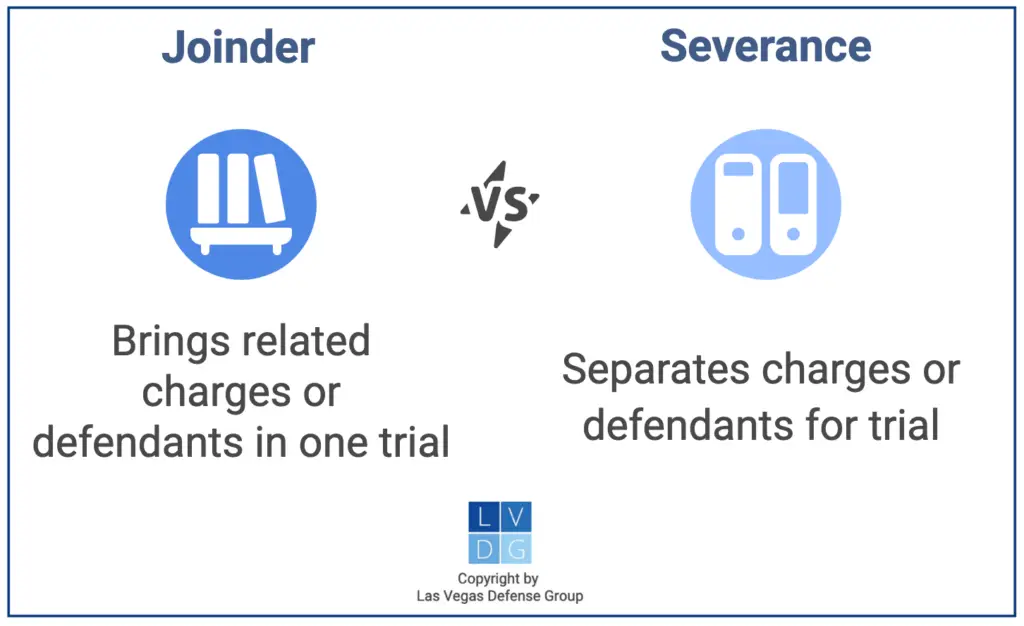
Joinder brings related charges or defendants together in one case or trial. Severance separates charges or defendants for trial.
Can I be tried with someone else without being charged with conspiracy?
Yes. Nevada allows defendants to be charged together when they allegedly participated in the same act, transaction, or series of criminal acts or transactions. A conspiracy charge is not required.
Being in the same case does not make you guilty of everything the other person allegedly did. Prosecutors still have to prove the charges against you.
Does blaming each other guarantee separate trials?
No. Conflicting defenses do not automatically require severance. The judge considers whether the joint trial seriously threatens a defendant’s trial rights or the jury’s ability to reach a reliable verdict.
Can a co-defendant’s confession be used against me?
A police confession directly accusing you can threaten your constitutional rights if the co-defendant does not testify and you cannot cross-examine them.
Your lawyer can seek to exclude the statement or challenge the joint trial. In some circumstances, a properly edited confession and a limiting instruction allow the trial to go forward without severance.
Does Nevada require an overt act to prove conspiracy?
Nevada law does not require proof of an additional act carrying out an unlawful agreement. Prosecutors must still prove that you joined the agreement.
Knowing the people involved or being nearby is not enough by itself to prove conspiracy. The prosecution has to prove you agreed to take part.
Does severance dismiss any charges?
No. Severance changes which charges or defendants are tried together. It does not itself dismiss a charge or establish that anyone is innocent.
Legal References
- NRS 173.115; NRS 173.135; NRS 174.155.
- NRS 173.135.
- NRS 174.165; Rodriguez v. State (2001) 117 Nev. 800, 32 P.3d 773 (standards for severance of defendants).
- NRS 199.480; NRS 199.490; Bolden v. State (2005) 121 Nev. 908, 124 P.3d 191 (agreement and proof of participation in a conspiracy; overruled on other grounds by Cortinas v. State (2008) 124 Nev. 1013, 195 P.3d 315).
- NRS 173.115(1).
- NRS 173.115(2)-(3).
- NRS 174.155.
- NRS 173.135.
- NRS 199.490; Bolden v. State, cited above.
- Rodriguez v. State, cited above.
- Rodriguez v. State, cited above; Floyd v. State (2002) 118 Nev. 156, 42 P.3d 249 (prejudice from joinder of offenses).
- Samia v. United States (2023) 599 U.S. 635 (admission of a confession edited to avoid directly identifying a co-defendant, with a limiting instruction); Bruton v. United States (1968) 391 U.S. 123 (footnote 6).
- NRS 174.165.
- NRS 174.125.
- NRS 177.015; NRS 177.045; Rodriguez v. State, cited above.
- Brown v. State (1998) 114 Nev. 1118, 967 P.2d 1126; Morales v. State (2006) 122 Nev. 966, 143 P.3d 463 (approving a bifurcated trial as an alternative to complete severance).