

Las Vegas Drug Court is a rehabilitation program that some first-time drug defendants may do instead of Nevada State Prison. The narcotics charge will be completely dismissed if you complete the program successfully.
The following flow chart outlines the drug court process:
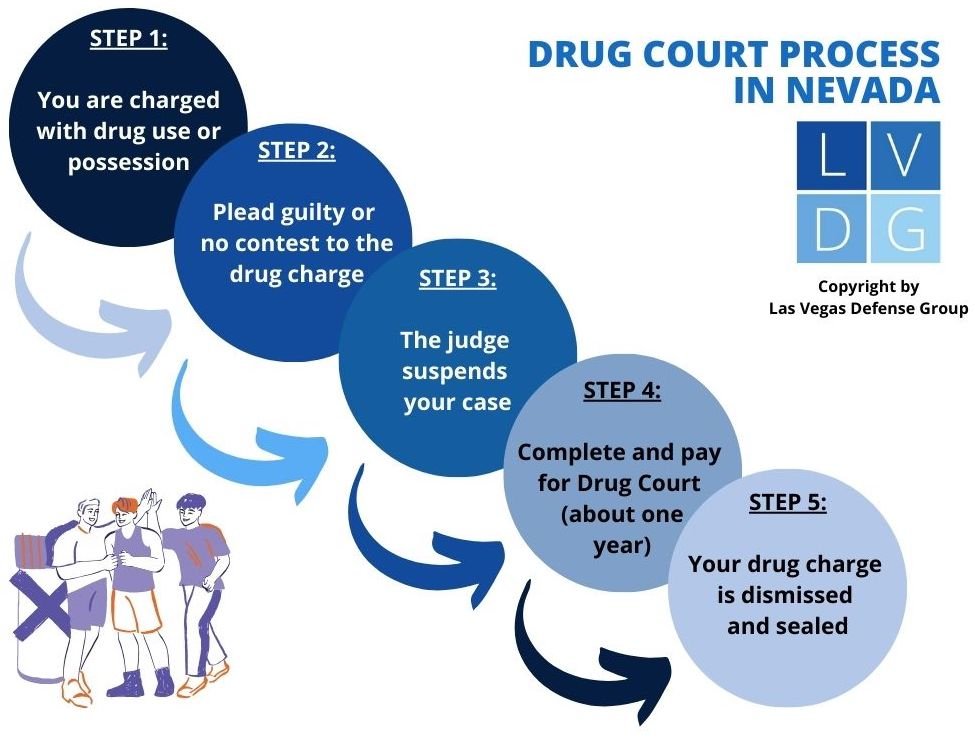
Below, our Nevada criminal defense lawyers answer the top 10 frequently asked questions about Drug Court in Las Vegas.
1. What is Drug Court in Las Vegas?
It is a rehabilitative alternative to prison in low-level narcotics cases.
There are various drug court programs in Las Vegas. Each offers specialized support according to age, gender, history, and parental status:
- Adult Drug Court (ADC): 18-month court-supervised inpatient and outpatient substance abuse treatment program.
- Felony DUI (FDUI): Three-to-five-year intensive treatment and community supervision for people with at least three DUI charges within seven years.
- Juvenile Drug Court: There are four programs for under-18 youths with narcotics problems:
- Pre-Adjudication Diversion Program: a 90-day program offering substance abuse and mental health counseling;
- First STEP: 90-day intensive substance abuse program;
- STEP Court: 9 month+ substance abuse program; or
- Transitional Program: 90-day program for youth transitioning into the community.
- Veterans Court: A court-supervised outpatient treatment for veterans convicted of a felony.
- Family Treatment Court: A court-supervised comprehensive outpatient substance abuse treatment geared for parents with children in the child welfare system.
- Transitional Age Drug Court Program (TAP): A minimum 18-month supervised comprehensive inpatient and outpatient substance abuse treatment program for people 18 to 26 years old.
- Law Enforcement Intervention for Mental Health and Addition (LIMA) Diversion Program: A pre-booking diversion program that spans at least 9 months.
- OPEN Program: This provides intensive behavioral modification programming for people from 18 to 26 years old with the aim of reintegrating them into society with the help of community-based resources.
- Gambling Treatment Diversion Court: This provides a supervised, comprehensive outpatient treatment program for people with addictive behaviors who have been convicted of a crime related to problem gambling.
- MAT Re-Entry Court: This serves people on early-release from prison or parolees who have an opioid and/or stimulant use disorder.
- Co-Occurring Disorders Court: Treatment for people with both mental health and substance use disorders.1

2. Who is eligible?
Las Vegas Drug Court is open to you if you are an addict facing a first-time charge of either:
- Felony possession (NRS 453.336),
- Unlawful drug use (NRS 453.411), or
- Misdemeanor possession (NRS 453.351)
Our clients who are non-addicts may also be able to avoid prison and a conviction for a first-time drug offense. However, instead of doing rehab, you could take a drug education class. This typically lasts only eight hours.2
3. What are the benefits?
Drug Court allows you to go on with your life because there is no prison. Upon completion, the narcotics charge will be dismissed.
We successfully enrolled hundreds of our clients who were suffering from substance disorders into this program, and we highly recommend it. Not only will you get the help you need and deserve, but you will also end up with a clean criminal drug record that will greatly improve your future employment prospects.3
4. What is Las Vegas Drug Court like?
In general, the program proceeds through four “phases”:
- Phase I: Orientation and early intervention:
- Orientation and intake
- Random urinalysis (UA)
- Counseling and classes
- Either remaining employed or receiving SSI or SSD
- Completion of Action Plan for Relapse
- Phase II: Therapeutic and education:
- Counseling three times a week (group and individual)
- 60 days of clean drug testing
- Phase III: Therapeutic process:
- Counseling twice a week (group and individual)
- Community service project for four hours per week
- UA
- Phase IV: Therapeutic Maintenance:
- Counseling once a week (group and individual)
- Mentoring a new Drug Court participant for 90 days
- 180 days of sobriety
- Completing the pre-graduation packet at least 30 days before graduation
- UA
We would also make regular court appearances with you at the Eighth Judicial District Court of Clark County, located at:
Regional Justice Center
200 Lewis Avenue
Las Vegas, NV 89155
(702) 671-3100
5. How long does it last?
Our clients typically complete Drug Court in one year. However, requirements may vary depending on the circumstances.
6. How much does it cost?
Las Vegas Drug Court costs about $1,500. There may be additional court fees and costs, which we strive to minimize or have waived altogether.
7. What is the process of getting into Drug Court?
We would confer with the prosecutors to take care of the technicalities, though the basic process under NRS 453.3363 goes like this:
- You plead guilty or “no contest” to the drug charge.
- The judge declines to convict. Instead, the judge suspends the case by putting you on probation.
- You complete the applicable rehab program in about a year.
- Upon completion, the judge dismisses the case.4

8. What happens if I break the rules?
Judges may punish non-compliance by throwing you out of rehab. This means that you would be convicted of the original narcotics charge and probably then face incarceration.
In our experience defending Drug Court participants, most judges give second chances and punish mistakes by ordering:
- Community service,
- Increased judicial supervision and/or counseling,
- House arrest, and/or
- A short jail term.5
9. What happens when I finish Drug Court?
The drug case will be dismissed entirely, and the case will be sealed. In other words, you will not have a conviction.6
However, if you get charged again, your dismissed drug charge will count as a prior conviction. Therefore, the punishment for the new drug charge will be harsher.
There is usually a small graduation ceremony to celebrate completing rehab.
10. Can I keep my old drug charge a secret?
If you graduate from Drug Court, you may legally deny — even under oath — that you were charged with drug use or possession.7
However, there are certain times you do need to reveal your past drug charges. This typically occurs when applying for a professional license, such as to become a doctor, lawyer, or nurse. Licensing boards are entitled to information about applicants’ entire criminal histories, including dismissed charges.
Additional Resources
- Clark County, NV Substance Abuse Courts: An explanation of all the different substance abuse courts offered in Las Vegas.
- Las Vegas Municipal Court Substance Abuse Program: A drug education program a Las Vegas Muni judge may order in place of jail.
- Narcotics Anonymous (NA): An AA-type program for addiction to controlled substances. It uses a 12-step program to aid people in defeating substance abuse.
- National Drug Court Institute (NDCI): As a division of the 501(c)3 non-profit The National Association of Drug Court Professionals (NADCP), the NDCI is an authority on research and practices re treating offenders suffering from drug addiction.
Legal References
- NRS 176.0613 (“[A] program established by a court to facilitate testing, treatment and oversight of certain persons over whom the court has jurisdiction and who the court has determined suffer from a mental illness or abuses alcohol or drugs.”). Eighth Judicial District Court Specialty Court Programs, Nevada. Drug Court Articles, Nevada Supreme Court. Specialty Courts, Las Vegas Municipal Courts.
- See same.
- See same.
- See same. See, for example, Locker v. State (2022) .
- See, for example, Newman v. State (2016) .
- See note 1. NRS 176.211. AB 4 (2025) (courts will not automatically seal charges involving elder or vulnerable abuse under NRS 200.5099 or child abuse or neglect under NRS 200.508).
- NRS 179.285.